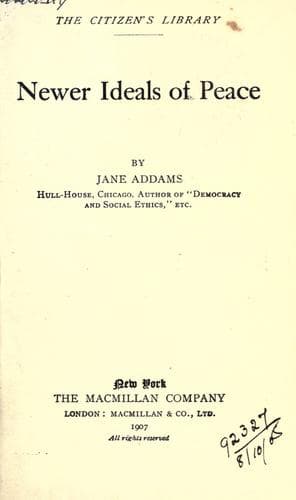
Municipal government -- United States; Peace; Political participation -- United States; Social justice; Working class -- United States
As yet no vigorous effort is made to discover how far our present
system of naturalization, largely resting upon laws enacted in 1802, is
inadequate, although it may have met the requirements of “the fathers.”
These processes were devised to test new citizens who had immigrated to
the United States from political rather than from economic pressure,
although these two have always been in a certain sense coextensive.
Yet the early Irish came to America to seek an opportunity for
self-government, denied them at home; the Germans and Italians started
to come in largest numbers after the absorption of their smaller
States into the larger nations; and the immigrants from Russia are the
conquered Poles, Lithuanians, Finns, and Jews. On some such obscure
notion the processes of naturalization were worked out, and, with a
certain degree of logic, the first immigrants were presented with the
Constitution of the United States as a type and epitome of that which
they had come to seek. So far as they now come in search of political
liberty, as many of them do every day, the test is still valid, but,
in the meantime, we cannot ignore those significant figures which show
emigration to rise with periods of depression in given countries, and
immigration to be checked by periods of depression in America, and we
refuse to see how largely the question has become an economic one.
At the present moment, as we know, the actual importing of immigrants
is left largely to the energy of steamship companies and to those
agents for contract labor who are keen enough to avoid the restrictive
laws. The business man is here again in the saddle, as he so largely
is in American affairs. From the time that the immigrants first make
the acquaintance of the steamship agent in their own villages, at
least until a grandchild is born on the new soil, they are subjected
to various processes of exploitation from purely commercial and
self-seeking interests. It begins with the representatives of the
transatlantic lines and their allies, who convert the peasant holdings
into money, and provide the prospective emigrants with needless
supplies, such as cartridge belts and bowie knives. The brokers, in
manufactured passports, send their clients by successive stages for
a thousand miles to a port suiting their purposes. On the way the
emigrants’ eyes are treated that they may pass the physical test; they
are taught to read sufficiently well to meet the literacy test; they
are lent enough money to escape the pauper test, and by the time they
have reached America, they are so hopelessly in debt that it requires
months of work to repay all they have received. During this time they
are completely under the control of the last broker in the line, who
has his dingy office in an American city. The exploitation continues
under the employment agency whose operations verge into those of the
politician, through the naturalization henchman, the petty lawyers who
Public-domain text, read in full here on John Shaqi.
Reviews
Reviews
No reviews yet
Be the first to share your thoughts on this work.
Join the Discussion
Join the discussion
Sign in to leave a comment or review.
Sign InorCreate an account