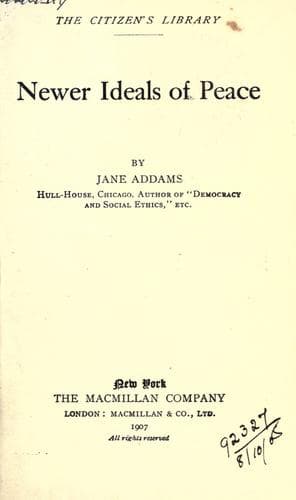
Municipal government -- United States; Peace; Political participation -- United States; Social justice; Working class -- United States
The instinctive protest against this mechanical method of civic
control, with the lack of adjustment between the natural democratic
impulse and the fixed external condition, inevitably produces the
indifferent citizen, and the so-called “professional politician.” The
first, because he is not vicious, feels that the real processes of
government do not concern him and wishes only to be let alone. The
latter easily adapts himself to an illegal avoidance of the external
fixed conditions by assuming that these conditions have been settled
by doctrinaires who did not in the least understand the people,
while he, the politician, makes his appeal beyond the conditions to
the real desires of the people themselves. He is thus not only “the
people’s friend,” but their interpreter. It is interesting to note
how often simple people refer to “them,” meaning the good and great
who govern but do not understand, and to “him,” meaning the alderman,
who represents them in these incomprehensible halls of State, as an
ambassador to a foreign country to whose borders they themselves could
not possibly penetrate, and whose language they do not speak.
In addition to this difficulty inherent in the difference between the
traditional and actual situation, there is another, which constantly
arises on the purely administrative side. The traditional governments
which the founders had copied, in proceeding by fixed standards to
separate the vicious from the good, and then to legislate against the
vicious, had enforced these restrictive measures by trained officials,
usually with a military background. In a democracy, however,
the officers entrusted with the enforcement of this restrictive
legislation, if not actually elected by the people themselves, are
still the appointments of those thus elected and are, therefore,
good-natured men who have made friends by their kindness and social
qualities. This is only decreasingly true even in those cities where
appointments are made by civil service examinations. The carrying out
of repressive legislation, the remnant of a military state of society,
in a democracy is at last put into the hands of men who have attained
office because of political pull. The repressive measures must be
enforced by those sympathizing with the people and belonging to those
against whom the measures operate. This anomalous situation produces
almost inevitably one result: that the police authorities themselves
are turned into allies of vice and crime. This may be illustrated
from almost any of the large American cities in the relation existing
between the police force and the gambling and other illicit life. The
officers are often flatly told that the enforcement of an ordinance
which the better element of the city has insisted upon passing, is
impossible; that they are expected to control only the robbery and
crime that so often associate themselves with vice. As Mr. Wilcox[5]
has recently pointed out, public sentiment itself assumes a certain
Public-domain text, read in full here on John Shaqi.
Reviews
Reviews
No reviews yet
Be the first to share your thoughts on this work.
Join the Discussion
Join the discussion
Sign in to leave a comment or review.
Sign InorCreate an account