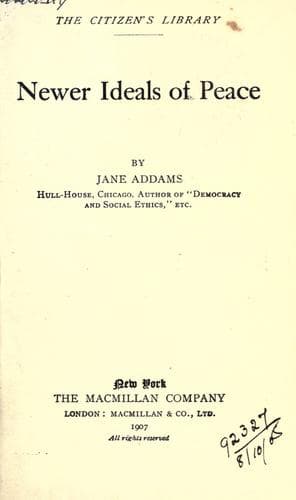
Municipal government -- United States; Peace; Political participation -- United States; Social justice; Working class -- United States
Let us imagine the result if, during the long anthracite strike, the
humane instinct had so over-mastered the minds of the strikers, and so
exalted their passions that they had lifted a hand against no man, even
though he seemed to be endangering their cause before their eyes. Such
a result might have come about, partly because the destruction of life
had become abhorrent and impossible to them engaged as they were in
the endeavor to raise life in the coal regions to a higher level, and
partly because they would have scorned to destroy an enemy in order
to achieve a mere negative result when the power lay within themselves
to convert him into an ally, when they might have made him a source
of help and power, a comrade of the same undertaking. If the element
of battle, of mere self-seeking, could be eliminated from strikes,
if they could remain a sheer uprising of the oppressed and underpaid
to a self-conscious recognition of their condition, so unified, so
irresistible as to sweep all the needy within its flood, we should have
a tide rising, not to destruction, but to beneficence. Let us imagine
the state of public feeling if there had been absolutely no act of
violence traceable, directly or indirectly, to the union miners; if
during the long months of the strike the great body of miners could
have added the sanction of sustained conduct to their creed. Public
sympathy would have led to an understanding of the need these miners
were trying to meet, and the American nation itself might have been
ready to ask for legislation concerning the minimum wage, and for
protection to life and limb, equal to the legislation of New Zealand
or Germany. But because the element of warfare unhappily did exist,
government got back to its old business of repression.
Public-domain text, read in full here on John Shaqi.
Reviews
Reviews
No reviews yet
Be the first to share your thoughts on this work.
Elsewhere in the archive
Join the Discussion
Join the discussion
Sign in to leave a comment or review.
Sign InorCreate an account