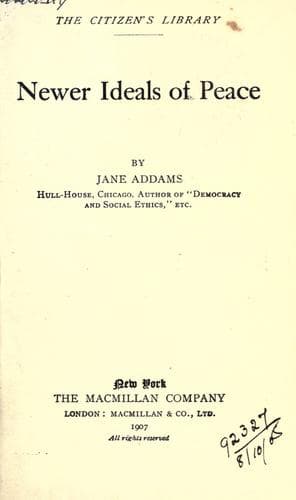
Municipal government -- United States; Peace; Political participation -- United States; Social justice; Working class -- United States
What, then, are we going to do about it? How deeply are we concerned
that this labor shall not result to the detriment of the child, and
what excuses are we making to ourselves for thus prematurely using up
the strength which really belongs to the next generation? Of course,
it is always difficult to see the wrong in a familiar thing; it is
almost a test of moral insight to be able to see that an affair of
familiar intercourse and daily living may also be wrong. I have taken a
Chicago street-car on a night in December at ten o’clock, when dozens
of little girls who had worked in the department stores all day were
also boarding the cars. I know, as many others do, that these children
will not get into their beds before midnight, and that they will have
to be up again early in the morning to go to their daily work. And yet
because I have seen it many times I take my car almost placidly--I am
happy to say, not quite placidly. Almost every day at six o’clock I see
certain factories pouring out a stream of men and women and boys and
girls. The boys and girls have a peculiar hue--a color so distinctive
that one meeting them on the street, even on Sunday when they are in
their best clothes and mingled with other children who go to school and
play out of doors, can distinguish them in an instant, and there is on
their faces a premature anxiety and sense of responsibility, which we
should declare pathetic if we were not used to it.
How far are we responsible when we allow custom to blind our eyes
to the things that are wrong? In spite of the enormous growth in
charitable and correctional agencies designed for children, are we
really so lacking in moral insight and vigor that we fail even to
perceive the real temptation of our age and totally fail to grapple
with it? An enlightened State which regarded the industrial situation
seriously would wish to conserve the ability of its youth, to give them
valuable training in relation to industry, quite as the old-fashioned
State carefully calculated the years which were the most valuable for
military training. The latter, looking only toward the preservation of
the State, took infinite pains, while we are careless in regard to the
much greater task which has to do with its upbuilding and extension. We
conscientiously ignore industry in relation to government and because
we assume that its regulation is unnecessary, so we conclude that the
protection of the young from premature participation in its mighty
operations is not the concern of the Government.
Public-domain text, read in full here on John Shaqi.
Reviews
Reviews
No reviews yet
Be the first to share your thoughts on this work.
Elsewhere in the archive
Join the Discussion
Join the discussion
Sign in to leave a comment or review.
Sign InorCreate an account