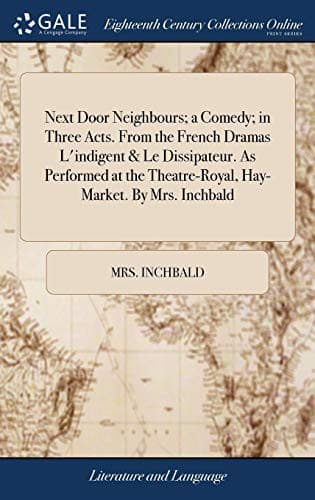
Next Door Neighbours: A Comedy; In Three ActsInchbald, Mrs.
General
Next Door Neighbours: A Comedy; In Three Acts
Inchbald, Mrs.
English drama (Comedy)
LADY CAROLINE. [_Coming forward._
No, Sir George, _nothing_--since I possess all that was yours.
SIR GEORGE.
How!
LADY CAROLINE.
Behold a friend in your necessities--a mistress whom your misfortunes
cannot drive away--but who, experiencing much of your unkindness,
still loves you; and knowing your every folly, will still submit to
honour, and obey you.
I received your lavish presents, but to hoard them for you--made
myself mistress of your fortune, but to return it to you--and with it,
all my own.
SIR GEORGE.
Can this be real? Can I be raised in one moment, from the depths of
misery to unbounded happiness?
_Enter_ SERVANT.
SERVANT.
A young man, who says he is Mr. Willford's son, is called to enquire
for him.
MANLY.
Shew him in.
[SIR GEORGE _and_ LADY CAROLINE _retire to the back part of
the stage_.
_Enter_ HENRY.
WILLFORD.
Come, Henry, and take leave of your sister for ever.
HENRY.
How so, sir?--What do you mean? To be parted from her, would be the
utmost rigour of fortune.
MANLY.
The affection with which you speak, young gentleman, seems to convey
something beyond mere brotherly love.
WILLFORD.
I some years since revealed to him she was _not_ his sister.
ELEANOR.
And he, some years since, implied it to me. Yet, in such doubtful
terms, I knew not which of us had the sorrow not to be your child.--I
now find it is myself--and I aver it to be a sorrow, for which, all
the fortune I am going to possess will not repay me.
SIR GEORGE.
Then, my dearest sister, indulge the hope you may yet be his daughter.
This young man's merit deserves a reward, and in _time_ he may learn
to love you by a still nearer tie than that, you have so long known to
exist between you; nay, even by a nearer tie than that of brother.
HENRY.
I am in doubt of what I hear--Eleanor, since our short separation,
there cannot surely have been any important discovery--
MANLY.
Be not surprised--great discoveries, which we labour in vain for years
to make, are frequently brought about in one lucky moment, without any
labour at all.
SIR GEORGE.
True--for till this day arose, I had passed every hour since my birth,
without making one discovery to my advantage--while this short, but
propitious morning, has discovered to me all my former folly--and
discovered to me--how to be in future happy.
THE END.
EPILOGUE,
BY T. VAUGHAN, ESQ.
SPOKEN BY MRS. KEMBLE.
Public-domain text, read in full here on John Shaqi.
Reviews
Reviews
No reviews yet
Be the first to share your thoughts on this work.
Join the Discussion
Join the discussion
Sign in to leave a comment or review.
Sign InorCreate an account