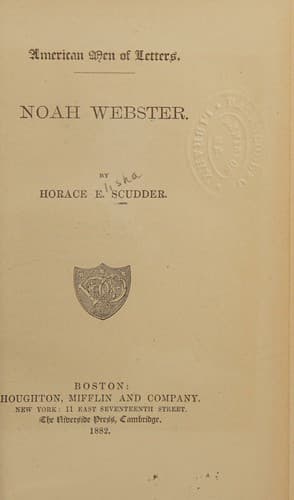
Noah Webster: American Men of LettersScudder, Horace Elisha
History
Noah Webster: American Men of Letters
Scudder, Horace Elisha
Educators -- United States -- Biography; Lexicographers -- United States -- Biography; Webster, Noah, 1758-1843
"This is a heavy accusation, Sir, from a gentleman of your talents,
liberality, and candor," he writes. "Sciolists we may have in
multitudes; but who are the men who would unsettle the whole of our
language? Can you name the men, or any of them, either in this country
or in England? Surely the finger of scorn ought to be pointed at the men
who are base enough to wish, and sottish enough to attempt, to unsettle
a whole language. I am confident, Sir, that deliberate reflection will
induce you to retract a charge so injurious to your fellow-citizens. It
certainly becomes you, and the character you maintain in society, to
learn the distinction between an attempt to find what the language is,
and an attempt to unsettle its principles. Whether you number me with
the thirsty reformers and presumptuous sciolists is a fact which I shall
take no pains to discover, nor, if known, would the fact give me the
smallest concern." Webster's hand trembles evidently with suppressed
anger, but he grows firmer as he goes on. "My studies have been
sometimes directed to philology, for the exclusive purpose of
ascertaining and unfolding its principles, correcting abuses, and
supplying the defect of rules in our elementary treatises. In the course
of my researches I have discovered a multitude of errors and false
principles, and numerous defects in such treatises; and as I have pushed
my inquiries probably much farther than any other man, I am satisfied
that the evidence I can lay before the public will convince you that
there is a rich mine of knowledge to be opened on this subject that your
English friends have never yet discovered." He takes up Pickering's
Vocabulary and rapidly criticises the several entries; he renews his
criticism upon Johnson and Lowth, but the most interesting part of the
pamphlet is his stout advocacy of the claim of Americans to make and
accept changes of language which grow out of their own conditions. The
English language was a common inheritance in England and America, and in
the necessary growth of a spoken language, Americans had equal right
with Englishmen to contribute to the growth; nay, that the American was
not a dialect of the English, but a variation; not a departure from a
standard existing in contemporary England, but an independent branch
from a common stock.
Public-domain text, read in full here on John Shaqi.
Reviews
Reviews
No reviews yet
Be the first to share your thoughts on this work.
Elsewhere in the archive
Join the Discussion
Join the discussion
Sign in to leave a comment or review.
Sign InorCreate an account