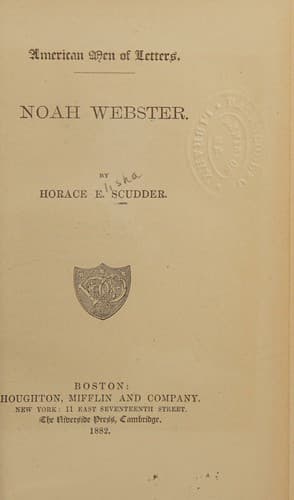
Noah Webster: American Men of LettersScudder, Horace Elisha
History
Noah Webster: American Men of Letters
Scudder, Horace Elisha
Educators -- United States -- Biography; Lexicographers -- United States -- Biography; Webster, Noah, 1758-1843
"New words should not be introduced into a copious language without
reason, nor contrary to its analogies. But a living language must keep
pace with improvements in knowledge, and with the multiplication of
ideas. Those who would entirely restrain the practice of using new words
seem not to consider that the limit they now prescribe would have been
as just and rational, a thousand or two thousand years ago, as it is at
this period. If it should be said, we have words enough to express all
our ideas, it may be truly answered, so had our ancestors when they left
the plains of Germany; or when they first crossed the Hellespont; or
when they left the soil of Persia. And what then? Would the words they
then used be now sufficient for our purpose. And who can define the
bounds of future improvement? Who will venture to allege that men have
not yet as much to learn as they have already learnt? The smallest
acquaintance with the history of human society and improvement ought to
silence the critics on this subject.
"Nor are we to believe that two nations inhabiting countries separated
by a wide ocean can preserve a perfect uniformity of language. If a
perfect uniformity cannot be produced or preserved in two distant
counties in England, how is this object to be effected between the
English in Great Britain and their descendants in America, India, or New
Holland? Let history answer the question. The art of printing,
interchange of books, and commercial intercourse will retard the
progress of mutation and diversities; but no human means can prevent
some changes, and the adaptation of language to diversities of condition
and improvement. The process of a living language is like the motion of
a broad river, which flows with a slow, silent, irresistible current."
He turns the tables on a writer who points out American barbarisms by
showing a number of English barbarisms which had been creeping into use,
and declares that in the use of language one nation as well as the other
will commit these errors, but he returns again and again to his position
that Americans in their use of language are not to wait passively upon
English authority.
Public-domain text, read in full here on John Shaqi.
Reviews
Reviews
No reviews yet
Be the first to share your thoughts on this work.
Elsewhere in the archive
Join the Discussion
Join the discussion
Sign in to leave a comment or review.
Sign InorCreate an account