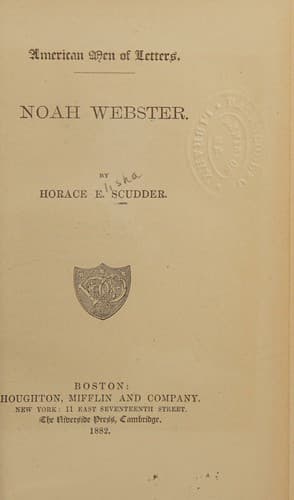
Noah Webster: American Men of LettersScudder, Horace Elisha
History
Noah Webster: American Men of Letters
Scudder, Horace Elisha
Educators -- United States -- Biography; Lexicographers -- United States -- Biography; Webster, Noah, 1758-1843
It is instructive to compare the preface with the celebrated one by Dr.
Johnson, introducing his dictionary. Webster, filled with a parochial
enthusiasm for his native country, exaggerates the necessity for a
local dictionary, and anticipates the vast audience that will one day
require his work. To him language is the instrument not so much of
literature as of daily association. He thinks of a dictionary as a book
of reference for the plain reader, and a guide to him in the correct use
of his vernacular. Johnson, proud of his literary heritage, burdened
with a sense of his own inadequacy, at once confesses the dignity of his
work and the melancholy of his own nature. He acknowledges the
limitation of his own philological attainments, and rests his claims to
honor upon the fullness with which he has gathered and arranged the
materials scattered through the vast area of English literature. The one
sees the subject from the side of nationality, the other from that of
literature. Webster is thinking of his own people, Johnson of the
un-national tribe of scholars and men of letters. The historical
associations justify each, for Johnson was distinctly the member of a
great class which was beginning to assert its independence of social
authority. With all his loyalty to his king, he was at heart a
republican in literature, and stoutly denied the divine right of
patrons. His dictionary was the sign of literary emancipation; it was
the witness to an intellectual freedom which might be in alliance with
government, but could not be its tool. The history of English literature
since that date is a democratic history. Webster, on his part, was the
prophet of a national independence, in which language and literature
were involved as inseparable elements. To him books were neither the
production nor the possession of a class, but necessarily incident to
the life of a free people. Hence, in his citation of American
authorities, he is undaunted by the paucity of purely literary men; law
reports and state documents answer his purpose as well. He saw
literature as the accompaniment of self-government, and the dictionary
in his eyes was a vast school-book, not a thesaurus of literature.
I can hardly expect my readers to follow me patiently through a close
examination of the successive editions of Webster's large dictionary,
and I have no such high opinion of my own patience as to suppose that I
should continue on the road after my readers had dropped behind; but it
is possible to make a rough comparison of the first edition of 1828 and
the latest of 1880, in order to see what Webster did which needed to be
undone, and to form some estimate of the substantial service which he
rendered lexicography in that edition which was more nearly his sole and
unaided work.
Public-domain text, read in full here on John Shaqi.
Reviews
Reviews
No reviews yet
Be the first to share your thoughts on this work.
Elsewhere in the archive
Join the Discussion
Join the discussion
Sign in to leave a comment or review.
Sign InorCreate an account