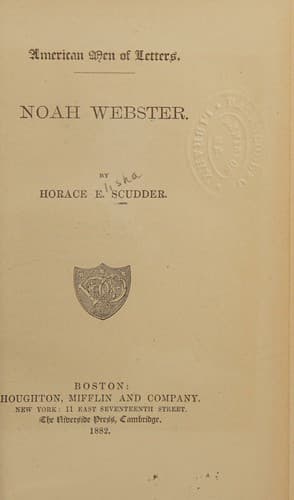
Noah Webster: American Men of LettersScudder, Horace Elisha
History
Noah Webster: American Men of Letters
Scudder, Horace Elisha
Educators -- United States -- Biography; Lexicographers -- United States -- Biography; Webster, Noah, 1758-1843
To take, then, the matter of orthography, there are certain general
classes of words which have borne the brunt of criticism. In his first
edition Webster's rule was to omit _k_ after _c_ from the end of all
words of more than one syllable, and to retain it in longer forms of the
same word only when it was required to defend the hard sound of c. He
wrote thus: _public_, _publication_. But Webster, like writers of
to-day, was constantly allowing his uniform rule to give way in cases
where custom had fastened upon him. Thus he still spelled _traffick_,
_almanack_, _frolick_, _havock_, and it was quite possible for his
critics to follow him through a long list of words of this class and
detect his frequent aberration from a uniform rule. Yet, instead of
receding from his position, the latest edition advances; a nicer
discrimination is made in the etymological origin of the variation, but
in point of practice a much more general conformity to the rule is
recorded. There can be no question that the _k_ has a foreign air when
found in such cases in American books.
Again, Webster omitted the _u_ in the unaccented termination _our_, as
_honor_ for _honour_. In this, too, he was not without English
precedent. Johnson was singularly inconsistent in this respect, and his
influence has extended over English orthography to the present day, so
that one cannot take up a well-printed English journal without
discovering an apparently arbitrary use of the termination. The usage as
recorded by Webster has held its ground, and there is no variation
between the first and latest editions, except that the alternative form
_Saviour_ is given in the latest as a concession to an undefined sense
of sanctity which would lead to a separation of the word from its class.
There is a foot-note in the edition of 1828, in which Washington's
omission of _u_ is cited as an argument in favor of the form _or_.
Public-domain text, read in full here on John Shaqi.
Reviews
Reviews
No reviews yet
Be the first to share your thoughts on this work.
Elsewhere in the archive
Join the Discussion
Join the discussion
Sign in to leave a comment or review.
Sign InorCreate an account