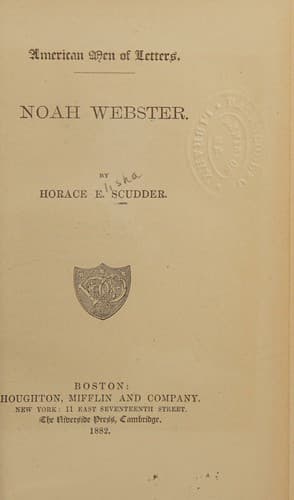
Noah Webster: American Men of LettersScudder, Horace Elisha
History
Noah Webster: American Men of Letters
Scudder, Horace Elisha
Educators -- United States -- Biography; Lexicographers -- United States -- Biography; Webster, Noah, 1758-1843
If any one had asked Webster upon what part of his Dictionary he had
expended the most time and now set the highest value, he would
undoubtedly have answered at once the etymology, and whatever related to
the history and derivation of words. The greater part of the time given
continuously, from 1807 to 1826, to the elaboration of his Dictionary
was spent upon this department; his severest condemnation of Johnson was
upon the score of his ignorance in these particulars, and the credit
which he took to himself was frank and sincere. There can be no doubt
that he worked hard; there can be no doubt, either, that he had his way
to make almost unaided by previous explorers. The science of comparative
philology is of later birth; the English of Webster's day were no better
equipped than he for the task which he undertook, except so far as they
were trained by scholarship to avoid an empirical method. Horne Tooke
was the man who opened Webster's eyes, and him he followed so long as
he followed anybody. But Tooke was a guesser, and Webster, with all his
deficiencies, had always a strong reliance upon system and method. He
made guesses also, but he thought they were scientific analyses, and he
came to the edge of real discoveries without knowing it.
The fundamental weakness of Webster's work in etymology lay in his
reliance upon external likenesses and the limitation of his knowledge to
mere vocabularies. It was not an idle pedantry which made him marshal an
imposing array of words from Oriental languages; he was on the right
track when he sought for a common ground upon which Indo-European
languages could meet, but he lacked that essential knowledge of
grammatical forms, without which a knowledge of the vocabulary is liable
to be misleading. His comparison of languages may be compared to the
earlier labors of students in comparative anatomy who mistook merely
external resemblances for structural homology. It would be idle to
institute any inquiry into the agreement of the 1828 edition with the
latest edition. All of Webster's original work, as he regarded it, has
been swept away, and the etymology reconstructed by Dr. Mahn, of Berlin,
in accordance with a science which did not exist in Webster's day. The
immense labor which Webster expended remains only as a witness to that
indomitable spirit which enabled him to keep steadfastly to his
self-imposed task through years of isolation.
Public-domain text, read in full here on John Shaqi.
Reviews
Reviews
No reviews yet
Be the first to share your thoughts on this work.
Elsewhere in the archive
Join the Discussion
Join the discussion
Sign in to leave a comment or review.
Sign InorCreate an account