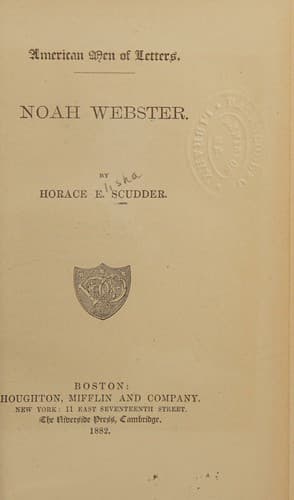
Noah Webster: American Men of LettersScudder, Horace Elisha
History
Noah Webster: American Men of Letters
Scudder, Horace Elisha
Educators -- United States -- Biography; Lexicographers -- United States -- Biography; Webster, Noah, 1758-1843
Now there never has been a time from Webster's day to this when
Americans have not believed and asserted that nationality consisted
mainly in independence, and waxed impatient not merely of foreign
control and influence, but even of hereditary influence: the temper
which calls for American characteristics in art and literature is often
scarcely less hostile to the past of American history than to the
present of European civilization. It is a restless, uneasy spirit,
goaded by self-consciousness. It finds in nature an aid and abettor; it
grows angry at the disproportionate place which the Cephissus, the Arno,
the Seine, the Rhine, and the Thames hold on the map of the world's
passion. We are all acquainted with the typical American who added to
his name in the hotel book on the shores of Lake Como, "What pygmy
puddles these are to the inland seas of tremendous and eternal America!"
But these are coarser, more palpable signs of that uneasy consciousness
which frets at a continued dependence on European culture.
There is no doubt that Webster was right when he set himself the task of
Americanizing the English language by a recourse to the Spelling-Book.
He succeeded very largely in determining the form of words; but he did
more than this, while he failed in the ambitious and preposterous task
which he set himself. He did more; by his shrewdness and his ready
perception of the popular need he made elementary education possible at
once, and furnished the American people with a key which moved easily in
the lock; he failed where he sought the most, because language is not a
toy or a patent machine, which can be broken, thrown aside at will, and
replaced with a better tool, ready-made from the lexicographer's shop.
He had no conception of the enormous weight of the English language and
literature, when he undertook to shovel it out of the path of American
civilization. The stars in their courses fought against him. It is so
still. We cannot dispense with European culture, because we refuse to
separate ourselves from the mighty past, which has settled there in
forms of human life unrepresented among us. We cannot step out of the
world's current, though it looks sluggish beside our rushing stream,
because there is a spiritual demand in us which cries louder than the
thin voice of a self-conscious national life. This demand is profoundly
at one with the deeper, holier sense of national being which does not
strut upon the world's stage. The humility of a great nation is in its
reverence for its own past, and, since that is incomplete, in its
admiration for whatever is noble and worthy in other nations. It is out
of this reverence and humility and this self-respect that great works
in literature and art grow, and not out of the overweening sensitiveness
which makes one's nationality but a petty jealousy of other people.
Public-domain text, read in full here on John Shaqi.
Reviews
Reviews
No reviews yet
Be the first to share your thoughts on this work.
Elsewhere in the archive
Join the Discussion
Join the discussion
Sign in to leave a comment or review.
Sign InorCreate an account