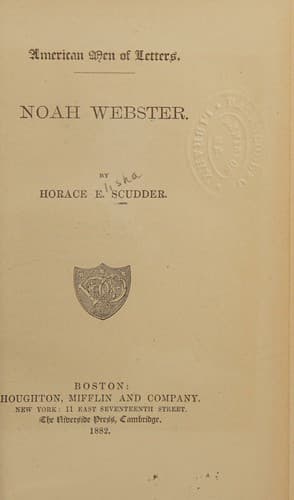
Noah Webster: American Men of LettersScudder, Horace Elisha
History
Noah Webster: American Men of Letters
Scudder, Horace Elisha
Educators -- United States -- Biography; Lexicographers -- United States -- Biography; Webster, Noah, 1758-1843
It is possible for us thus to discriminate between a nationality which
is a mere posture and that which is a plain expression of positive
organic life. When we measure the force of the latter we are compelled
to a finer analysis, and its illustrations are to be sought in subtler
manifestations. Webster well exemplifies, by the very rudeness of his
mind, phases of Americanism which may be traced in more delicate lines
elsewhere. There can be no doubt that self-reliance, which was both the
cause and the effect of local self-government long practiced, has been a
powerful factor in American life; that an indifference to the past has
often been only the obverse of an elastic hope, a consciousness of
destiny; that a fearlessness and a spirit of adventure have been invited
by the large promises held out by nature; that an expansiveness of mind,
and an alertness and facility in intellectual device, have been
encouraged by the flexile condition of American society. All things
have seemed possible to the ardent American, and each has secretly said
to himself:--
"I ... had resolved to be
The maker of my destiny."
These elements of character have entered into literature, the exponent
of character; and Webster, with his self-reliance, his indifference to
the past, his consciousness of destiny, his courage and resolution and
quick fitting into his country's work, stands easily as the first
aggressive American in our literature. In him we see roughly marked what
future critics will discern of men more readily assigned a place in
universal literature. The Americanism of Hawthorne, for example, differs
from that of Webster in quality rather than in essence. They were both
content with America and New England. Hawthorne, with his shrug at old
buildings and his wish that all over two hundred years of age should be
burnt down, was repeating Webster's contempt of the musty halls of
collegiate Cambridge; and Hawthorne, Yankeeizing the Greek myths, and
finding all Rome but the background for his Puritan maiden, was
asserting that new discovery of Europe by America which has ever since
been going on, and was illustrated by Webster's excursions in language
to bring back English variations from American usage.
Public-domain text, read in full here on John Shaqi.
Reviews
Reviews
No reviews yet
Be the first to share your thoughts on this work.
Elsewhere in the archive
Join the Discussion
Join the discussion
Sign in to leave a comment or review.
Sign InorCreate an account