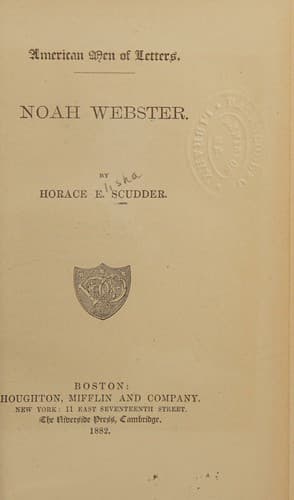
Noah Webster: American Men of LettersScudder, Horace Elisha
History
Noah Webster: American Men of Letters
Scudder, Horace Elisha
Educators -- United States -- Biography; Lexicographers -- United States -- Biography; Webster, Noah, 1758-1843
The ease with which Webster walked about the Jericho of English
lexicography, blowing his trumpet of destruction, was an American ease,
born of a sense that America was a continent and not a province. He
transferred the capital of literature from London to Boston, or New
York, or Hartford,--he was indifferent so long as it was in the United
States. He thought Washington as good an authority on spelling as Dr.
Johnson, and much better than King George. He took the Bible as a book
to be used, not as a piece of antiquity to be sheltered in a museum, and
with an American practicality set about making it more serviceable in
his own way. He foresaw the vast crowds of American children; he knew
that the integrity of the country was conditioned on the intelligibility
of their votes, and he turned his back on England less with indifference
to her than with an absorption in his own country. He made a Speller
which has sown votes and muskets; he made alone a Dictionary, which has
grown, under the impulse he gave it, into a national encyclopædia,
possessing an irresistible momentum. Indeed, is not the very existence
of that book in its current form a witness to the same Americanism which
Webster displayed, only now in a firmer, finer, and more complex form?
In the high walks of scholarship, where nationality would seem to be
effaced, we have had very recently a capital illustration of the
inevitable tendency of national traits to seek expression. The Appendix
to the "Revised Version of the New Testament" contains the variations
proposed by the American company from the text as otherwise determined.
There were in the English company men of radical temperament and of
conservative; there were in the American company like distinctions;
nevertheless the final separation between the two companies is largely
on this line, and one can easily see how much sympathy, Webster, for
example, would have expressed with the position which the American
company took, a position not of dissent but of independent assertion.
The separation between England and America which was so effectual in
Webster's conception, and thus determined much of his thought, was
really incipient and not complete. The two countries are more widely
separate to-day than they were then, while the outward signs of
separation are in many ways less conspicuous. The forces of national
life have been diverging, and the resultant in character and literature
is more sure and ineffaceable.
Public-domain text, read in full here on John Shaqi.
Reviews
Reviews
No reviews yet
Be the first to share your thoughts on this work.
Elsewhere in the archive
Join the Discussion
Join the discussion
Sign in to leave a comment or review.
Sign InorCreate an account