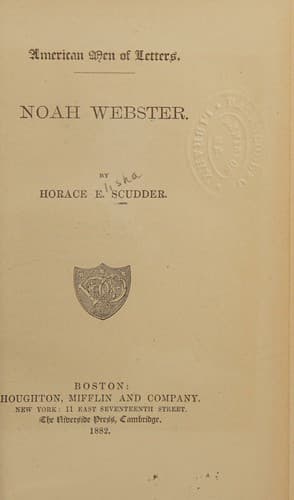
Noah Webster: American Men of LettersScudder, Horace Elisha
History
Noah Webster: American Men of Letters
Scudder, Horace Elisha
Educators -- United States -- Biography; Lexicographers -- United States -- Biography; Webster, Noah, 1758-1843
"'Among all modes of acquiring property, or exclusive ownership, the act
or operation of _creating_ or _making_ seems to have the first claim.
If anything can justly give a man an exclusive right to the occupancy
and enjoyment of a thing it must be the fact that he _made_ it. The
right of a farmer and mechanic to the exclusive enjoyment and right of
disposal of what they _make_ or _produce_ is never questioned. What,
then, can make a difference between the produce of _muscular strength_
and the produce of the _intellect_? If it should be said that as the
purchaser of a bushel of wheat has obtained not only the exclusive right
to the use of it for food, but the right to sow it and increase and
profit by it, let it be replied, this is true; but if he sows the wheat
he must sow it on his own ground or soil. The case is different with
respect to the copy of a book, which a purchaser has obtained, for the
copyright is the _author's soil_, which the purchaser cannot legally
occupy.
"'Upon what principles, let me ask, can any fellow-citizens declare that
the production of the farmer and the artisan shall be protected by
common law, or the principles of natural and social rights, without a
special statute, and without paying a premium for the enjoyment of their
property, while they declare that I have only a temporary right to the
fruits of my labor, and even this cannot be enjoyed without giving a
premium? Are such principles as these consistent with the established
doctrines of property, and of moral right and wrong among an enlightened
people? Are such principles consistent with the high and honorable
notions of justice and equal privileges which our citizens claim to
entertain and to cherish, as characteristic of modern improvements in
civil society? How can the _recent origin_ of a particular species of
property vary the principles of ownership? I say nothing of the
inexpedience of such a policy, as it regards the discouragement of
literary exertions. Indeed, I can probably say nothing on this subject
that you have not said or thought; at least I presume you have often
contemplated this subject in all its bearings.
"'The British Parliament, about ten or twelve years ago, passed a new
act on this subject, giving to authors and proprietors of new works an
absolute right to the exclusive use of the copyright for twenty-eight
years, with some other provisions which I do not recollect; but the act
makes or continues the condition that the author or proprietor shall
deposit _eleven copies_ of the work in Stationers' Hall, for the benefit
of certain public libraries. This premium will often amount to _fifty
pounds sterling_, or more. An effort was made by publishers to obtain a
repeal of this provision; but it was opposed by the institutions which
were to receive the benefit, and the attempt failed.
Public-domain text, read in full here on John Shaqi.
Reviews
Reviews
No reviews yet
Be the first to share your thoughts on this work.
Join the Discussion
Join the discussion
Sign in to leave a comment or review.
Sign InorCreate an account