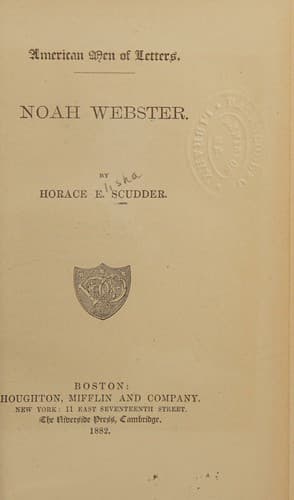
Noah Webster: American Men of LettersScudder, Horace Elisha
History
Noah Webster: American Men of Letters
Scudder, Horace Elisha
Educators -- United States -- Biography; Lexicographers -- United States -- Biography; Webster, Noah, 1758-1843
Literature in its finer forms had but slender encouragement. The absence
of easy communication, the poverty of the people, the dispersion of the
population, gave little chance for bookstores and circulating libraries
and private accumulation. It must not be forgotten, either, that the era
of cheap books had not yet come in England, and that the periodical form
was still in embryo. To look back on one of the rather juiceless
periodicals which sprang up so frequently at the beginning of our
literature because they had no depth of earth, and withered away
rootless and sunstruck, is to be over-taken half with scorn for their
pretense, and half with pity for conductors and readers, who had to make
believe very hard to find them quite nice. "They would bear a little
more seasoning certainly," like the marchioness's orange-peel and water;
yet how strong must have been the passion for literature when money was
expended and pains taken with these hopeless ventures. The change in
popular taste, moreover, must not mislead us into supposing that
writings which are arid to us now were necessarily devoid of interest to
contemporary readers. We take down from the shelf the solitary volume
which contains the "American Magazine," and its reading-matter looks as
faded to our eyes as the leather upon the covers, but it was once the
latest publication of the day. We can with little difficulty imagine
that the monthly report of Warren Hastings' trial, with its plan of the
High Court at Westminster, would have an interest at the time quite as
reasonable in its way as that which held readers of journals, not so
long extinct, over the details of the Tichborne case. It is in the field
of polite literature that our later taste refuses to discover anything
in common with the readers of the "American Magazine." What impresses
one most in such a periodical is the value which the conductors set upon
American historical material. This was offered to the public with all
the assurance which now attends the promise of a great serial story. The
explanation may most reasonably be found in the fact, that the
subscribers to any such magazine at the time must have been sought among
the well educated, and this class had been used chiefly to a serious
view of literature.
Public-domain text, read in full here on John Shaqi.
Reviews
Reviews
No reviews yet
Be the first to share your thoughts on this work.
Join the Discussion
Join the discussion
Sign in to leave a comment or review.
Sign InorCreate an account