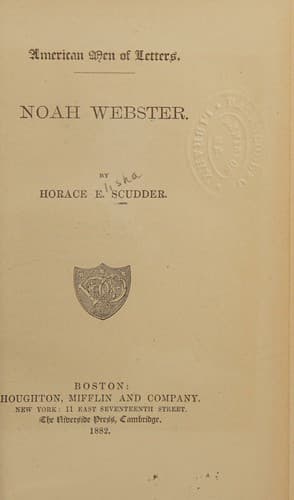
Noah Webster: American Men of LettersScudder, Horace Elisha
History
Noah Webster: American Men of Letters
Scudder, Horace Elisha
Educators -- United States -- Biography; Lexicographers -- United States -- Biography; Webster, Noah, 1758-1843
... "In the present [King James] version, the language is, in general,
correct and perspicuous; the genuine popular English of Saxon origin;
peculiarly adapted to the subjects; and in many passages uniting
sublimity with beautiful simplicity. In my view, the general style of
the version ought not to be altered. But in the lapse of two or three
centuries changes have taken place, which in particular passages impair
the beauty, in others obscure the sense, of the original languages. Some
words have fallen into disuse; and the signification of others, in
current popular use, is not the same now as it was when they were
introduced into the version. The effect of these changes is that some
words are not understood by common readers, who have no access to
commentaries, and who will always compose a great proportion of readers;
while other words, being now used in a sense different from that which
they had when the translation was made, present a wrong signification or
false ideas. Whenever words are understood in a sense different from
that which they had when introduced, and different from that of the
original languages, they do not present to the reader the Word of God.
This circumstance is very important, even in things not the most
essential; and in essential points mistakes may be very injurious. In my
own view of this subject, a version of the Scriptures for popular use
should consist of words expressing the sense which is most common in
popular usage, so that the first ideas suggested to the reader should be
the true meaning of such words according to the original languages. That
many words in the present version fail to do this is certain. My
principal aim is to remedy this evil....
"In performing this task I have been careful to avoid unnecessary
innovations, and to retain the general character of the style. The
principal alterations are comprised in three classes:--
"1. The substitution of words and phrases now in good use for such as
are wholly obsolete, or deemed below the dignity and solemnity of the
subject.
"2. The correction of errors in grammar.
"3. The insertion of euphemisms, words and phrases which are not very
offensive to delicacy, in the place of such as cannot, with propriety,
be uttered before a promiscuous audience."
Public-domain text, read in full here on John Shaqi.
Reviews
Reviews
No reviews yet
Be the first to share your thoughts on this work.
Elsewhere in the archive
Join the Discussion
Join the discussion
Sign in to leave a comment or review.
Sign InorCreate an account