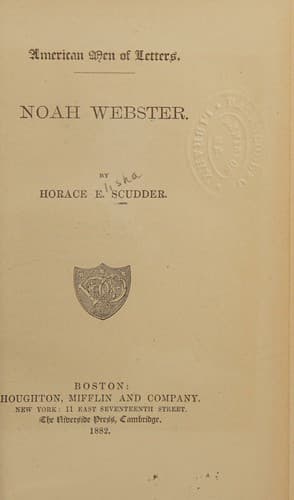
Noah Webster: American Men of LettersScudder, Horace Elisha
History
Noah Webster: American Men of Letters
Scudder, Horace Elisha
Educators -- United States -- Biography; Lexicographers -- United States -- Biography; Webster, Noah, 1758-1843
In every community there was likely to
be one woman or more to whom the rest turned in emergencies, and a rude
practice was kept up which cannot be called quackery, for it was
entirely unpretentious. Something also was due to the knowledge derived
from the Indians, whose closeness to nature was supposed to give them
excellent opportunities for wresting secrets from simples. This respect
for the Indian school survives still, and affords a support to the queer
practitioners who call themselves Indian Doctors. It was never strange,
therefore, when a man who had received a liberal education turned his
attention to questions which nowadays a layman would scarcely venture to
discuss. He was not regarded as an amateur, but as occupying himself
with a legitimate part of his business.
Even more surely was the educated man a lawyer. There was always a good
deal of litigation going on in Connecticut, but the legal profession
scarcely existed as a distinct body until Webster himself came upon the
stage. Plaintiff and defendant addressed the court if they desired, and
in the loose practice of the day there were no intricate and technical
processes which debarred any intelligent man from taking part in a
cause. Substantial justice was done, and every citizen took part in
legal affairs with confidence that he only needed perseverance and a
fair cause to achieve success. Above all, the constant and familiar
participation in public concerns was a school for the citizen, in which
he learned thoroughly the art of legislation, and acquired a readiness
in government which stood him in good stead when the scope of
governmental power was enlarged. The New England town was always the
centre of political life, and each member of the town learned early his
inalienable right to a participation in all the benefits which the
community could confer. In town-meeting he learned to vote and to be
voted for; a gradation of offices from fence-viewer or hog-reeve to
selectman gave training in administration to all who had any capacity
for organization or leadership; the discussion of town affairs sharpened
the wits, and, better still, educated the towns-man in a distinct
recognition of his political relations; he learned to think politically,
and as the Revolution drew near, the petty interests of the local
community widened into larger questions of state when the towns
themselves found that they were parts of a larger body corporate. Then
the principle of representation was constantly delocalizing the town,
and bringing into the arena subjects which reminded men of their
relationship to the state and the crown. Men who had grown up under the
discussion of questions which involved great historic processes were not
likely, when the occasion came, to hold back from writing or speaking on
great national themes, merely because they were not publicists by
profession.
Public-domain text, read in full here on John Shaqi.
Reviews
Reviews
No reviews yet
Be the first to share your thoughts on this work.
Join the Discussion
Join the discussion
Sign in to leave a comment or review.
Sign InorCreate an account