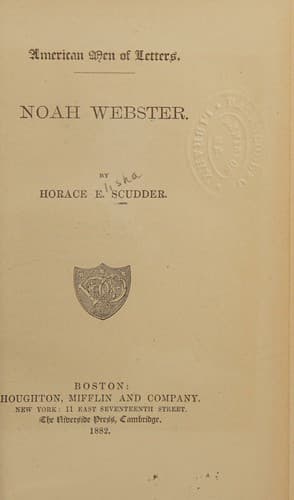
Noah Webster: American Men of LettersScudder, Horace Elisha
History
Noah Webster: American Men of Letters
Scudder, Horace Elisha
Educators -- United States -- Biography; Lexicographers -- United States -- Biography; Webster, Noah, 1758-1843
"Besides this, a _national language_ is a band of _national union_.
Every engine should be employed to render the people of this country
_national_; to call their attachments home to their own country; and to
inspire them with the pride of national character. However they may
boast of independence, and the freedom of their government, yet their
_opinions_ are not sufficiently independent; an astonishing respect for
the arts and literature of their parent country, and a blind imitation
of its manners, are still prevalent among the Americans. Thus an
habitual respect for another country, deserved indeed and once laudable,
turns their attention from their own interests, and prevents their
respecting themselves."
He supposes various objections to this reform: that it would oblige
people to relearn the language; that it would render present books
useless; that it would injure the language by obscuring etymology; that
the distinction between words of different meanings and similar sound
would be destroyed; that it was idle to conform the orthography of words
to the pronunciation, because the latter was continually changing. All
these objections he considers and meets with arguments more familiar to
us than they were to men of his day, and then concludes:--
"Sensible I am how much easier it is to _propose_ improvements than to
_introduce_ them. Everything new starts the idea of difficulty, and yet
it is often mere novelty that excites the appearance; for on a slight
examination of the proposal the difficulty vanishes. When we firmly
believe a scheme to be practicable, the work is half accomplished. We
are more frequently deterred by fear from making an attack, than
repulsed in the encounter.
"Habit also is opposed to changes, for it renders even our errors dear
to us. Having surmounted all difficulties in childhood, we forget the
labor, the fatigue, and the perplexity we suffered in the attempt, and
imagine the progress of our studies to have been smooth and easy. What
seems intrinsically right is so merely thro habit. Indolence is another
obstacle to improvements. The most arduous task a reformer has to
execute is to make people _think_; to rouse them from that lethargy,
which, like the mantle of sleep, covers them in repose and contentment.
"But America is in a situation the most favorable for great
reformations; and the present time is, in a singular degree, auspicious.
The minds of men in this country have been awakened. New scenes have
been, for many years, presenting new occasions for exertion; unexpected
distresses have called forth the powers of invention; and the
application of new expedients has demanded every possible exercise of
wisdom and talents. Attention is roused, the mind expanded, and the
intellectual faculties invigorated. Here men are prepared to receive
improvements, which would be rejected by nations whose habits have not
been shaken by similar events.
Public-domain text, read in full here on John Shaqi.
Reviews
Reviews
No reviews yet
Be the first to share your thoughts on this work.
Elsewhere in the archive
Join the Discussion
Join the discussion
Sign in to leave a comment or review.
Sign InorCreate an account