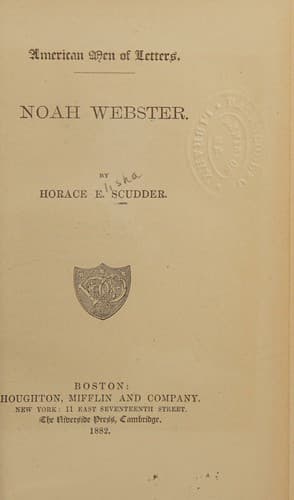
Noah Webster: American Men of LettersScudder, Horace Elisha
History
Noah Webster: American Men of Letters
Scudder, Horace Elisha
Educators -- United States -- Biography; Lexicographers -- United States -- Biography; Webster, Noah, 1758-1843
"_Now_ is the time, and _this_ the country, in which we may expect
success in attempting changes favorable to language, science, and
government. Delay in the plan here proposed may be fatal; under a
tranquil general government the minds of men may again sink into
indolence; a national acquiescence in error will follow, and posterity
be doomed to struggle with difficulties which time and accident will
perpetually multiply.
"Let us, then, seize the present moment and establish a _national
language_ as well as a national government. Let us remember that there
is a certain respect due to the opinions of other nations. As an
independent people, our reputation abroad demands that, in all things,
we should be federal, be _national_; for, if we do not respect
ourselves, we may be assured that other nations will not respect us. In
short, let it be impressed upon the mind of every American, that to
neglect the means of commanding respect abroad is treason against the
character and dignity of a brave, independent people."
In the matter of pronunciation, Webster asserted similar principles in
his earliest essays. He denounces the custom of referring to English
standards for the determination of sounds. In the "Remarks on the
Manners, Government, and Debt of the United States," which I quoted in
the last chapter, he finds fault with his countrymen for their
dependence upon England.
"This same veneration for eminent foreigners and the bewitching charms
of fashion have led the Americans to adopt the modern corruptions of our
language. Very seldom have men examined the structure of the language to
find reasons for their practice. The pronunciation and use of words have
been subject to the same arbitrary or accidental changes as the shape of
their garments. My lord wears a hat of a certain size and shape; he
pronounces a word in a certain manner; and both must be right, for he is
a fashionable man. In Europe this is right in dress; and men who have
not an opportunity of learning the just rules of our language are in
some degree excusable for imitating those whom they consider as
superiors. But in men of science this imitation can hardly be excused.
Our language was spoken in purity about eighty years ago, since which
time great numbers of faults have crept into practice about the theatre
and court of London. An affected, erroneous pronunciation has in many
instances taken place of the true, and new words or modes of speech have
succeeded the ancient correct English phrases. Thus we have, in the
modern English pronunciation, their natshures, conjunctshures,
constitshutions, and tshumultshuous legislatshures, and a long catalogue
of fashionable improprieties. These are a direct violation of the rules
of analogy and harmony; they offend the ear and embarrass the language.
Time was when these errors were unknown; they were little known in
America before the Revolution. I presume we may safely say that our
Public-domain text, read in full here on John Shaqi.
Reviews
Reviews
No reviews yet
Be the first to share your thoughts on this work.
Elsewhere in the archive
Join the Discussion
Join the discussion
Sign in to leave a comment or review.
Sign InorCreate an account