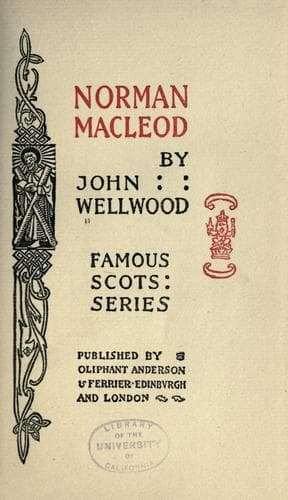
NORMAN MACLEOD
INTRODUCTION
If any modern minister has a place, though it were the least, among the
worthies of his nation, he must have been a surprising personality.
When Scottish life was based on Calvinism, and there was a Stuart
deforming the Kirk at the sword’s point, a preacher might rise to be
a leader of the people, if not a virtual ruler in the kingdom. From
Knox to Carstairs the line of famous Scots (such as they are) is black
with Geneva gowns. But for two hundred years the Protestant spirit has
gone all to democracy and the march of intellect, while the clergy have
stood by the vacant symbol, exiled--
‘From the dragon-warder’d fountains
Where the springs of knowledge are,
From the watchers on the mountains
And the bright and morning star.’
So the Church has come down in the world. Her affairs are her own, and
subject to journalistic irony; with few exceptions her leaders, for
all the noise they may make in their day and generation, have only
to die to be forgotten. One calls to mind certain men who were not in
holy orders, mere sages or poets, and knows them for the real teachers
of their times. In Norman Macleod the hero as priest reappears, but at
some cost to the clerical tradition. Making little of dogma, and less
of rites, he went deep down into the common heart for his ground of
appeal, and on his lips love, divine and human, was a tale to move the
philosopher and win the crowd. His work in the world was to make men
good after the pattern of Jesus, and to that work he brought a burning
belief, a boundless sympathy, and rare oratorical and literary gifts.
One in the throng at the funeral of this great minister was heard to
say, ‘There goes Norman Macleod. If he had done no more than what he
did for my soul, he would shine as the stars for ever.’ And the like
might have been confessed by thousands; nay, many who never heard his
voice nor saw his face were better for the rumour of such a man. His
name went from the Church to the nation, and over all English-speaking
lands; and with that of Chalmers has endured.
CHAPTER I
1812-1837
DESCENT--BOYHOOD--STUDENT YEARS
Public-domain text, read in full here on John Shaqi.
Reviews
Reviews
No reviews yet
Be the first to share your thoughts on this work.
Join the Discussion
Join the discussion
Sign in to leave a comment or review.
Sign InorCreate an account