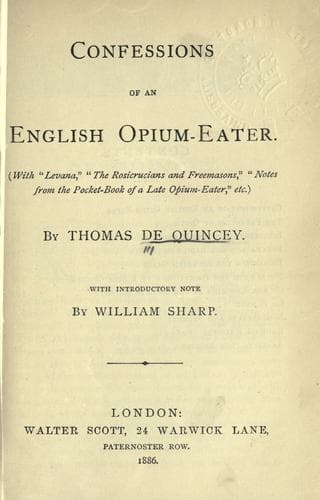
Note Book of an English Opium-EaterDe Quincey, Thomas
Philosophy
Note Book of an English Opium-Eater
De Quincey, Thomas
Opium abuse -- England
than in a scenic theatre to the surrounding spectators. Allow for this,
and placing some adult in a station expressing the distance of the
Athenian stage, then judge by his appearance if the delicate pencilling of
Grecian features could have told at the Grecian distance. But even if it
could, then I say that this circumstantiality would have been hostile to
the general tendencies (as already indicated) of the Grecian drama. The
sweeping movement of the Attic tragedy _ought_ not to admit of
interruption from _distinct_ human features; the expression of an
eye, the loveliness of a smile, _ought_ to be lost amongst effects so
colossal. The mask aggrandized the features: even so far it acted
favorably. Then figure to yourself this mask presenting an idealized face
of the noblest Grecian outline, moulded by some skilful artist _Phidiaca
manu_, so as to have the effect of a marble bust; this accorded with
the aspiring _cothurnus_; and the motionless character impressed upon
the features, the marble tranquillity, would (I contend) suit the solemn
processional character of Athenian tragedy, far better than the most
expressive and flexible countenance on its natural scale. 'Yes,' you say,
on considering the character of the Greek drama, 'generally it might; in
forty-nine cases suppose out of fifty: but what shall be done in the
fiftieth, where some dreadful discovery or _anagnorisis_ (_i.e._
recognition of identity) takes place within the compass of a single line
or two; as, for instance, in the Oedipus Tyrannus, at the moment when
Oedipus by a final question of his own, extorts his first fatal discovery,
viz. that he had been himself unconsciously the murderer of Laius?' True,
he has no reason as yet to suspect that Laius was his own father; which
discovery, when made further on, will draw with it another still more
dreadful, viz. that by this parricide he had opened his road to a throne,
and to a marriage with his father's widow, who was also his own natural
mother. He does not yet know the worst: and to have killed an arrogant
prince, would not in those days have seemed a very deep offence: but then
he believes that the pestilence had been sent as a secret vengeance for
this assassination, which is thus invested with a mysterious character of
horror. Just at this point, Jocasta, his mother and his wife, says, [8] on
witnessing the sudden revulsion of feeling in his face, 'I shudder, oh
king, when looking on thy countenance.' Now, in what way could this
passing spasm of horror be reconciled with the unchanging expression in
the marble-looking mask? This, and similar cases to this, must surely be
felt to argue a defect in the scenic apparatus. But I say, no: first,
Because the general indistinctiveness from distance is a benefit that
applies equally to the fugitive changes of the features and to their
permanent expression. You need not regret the loss through _absence_,
of an appearance that would equally, though present, have been lost
Public-domain text, read in full here on John Shaqi.
Reviews
Reviews
No reviews yet
Be the first to share your thoughts on this work.
Elsewhere in the archive
Join the Discussion
Join the discussion
Sign in to leave a comment or review.
Sign InorCreate an account