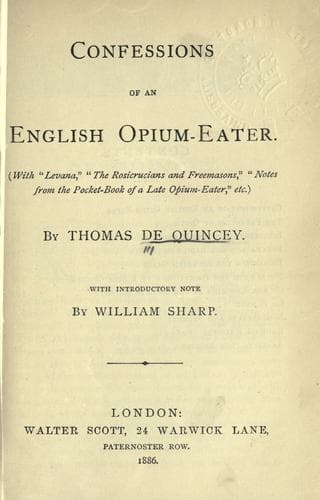
Note Book of an English Opium-EaterDe Quincey, Thomas
Philosophy
Note Book of an English Opium-Eater
De Quincey, Thomas
Opium abuse -- England
Connected with this original awfulness of the Greek tragedy, and possibly
in part its cause, or at least lending strength to its cause, we may next
remark the grand dimensions of the ancient theatres. Every citizen had a
right to accommodation. _There_ at once was a pledge of grandeur. Out
of this original standard grew the magnificence of many a future
amphitheatre, circus, hippodrome. Had the original theatre been merely a
speculation of private interest, then, exactly as demand arose, a
corresponding supply would have provided for it through its ordinary
vulgar channels; and this supply would have taken place through rival
theatres. But the crushing exaction of 'room for _every_ citizen,' put an
end to that process of subdivision. Drury Lane, as I read (or think
that I read) thirty years ago, allowed sitting room for three thousand
eight hundred people. Multiply _that_ by ten; imagine thirty-eight
thousand instead of thirty-eight hundred, and then you have an idea of the
Athenian theatre. [7]
Next, out of that grandeur in the architectural proportions arose, as by
necessity, other grandeurs. You are aware of the _cothurnus_, or buskin,
which raised the actor's heel by two and a half inches; and you think that
this must have caused a deformity in the general figure as incommensurate
to this height. Not at all. The flowing dress of Greece healed all _that_.
But, besides the _cothurnus_, you have heard of the mask. So far as
it was fitted to swell the intonations of the voice, you are of opinion
that this mask would be a happy contrivance; for what, you say, could a
common human voice avail against the vast radiation from the actor's
centre of more than three myriads? If, indeed (like the Homeric Stentor),
an actor spoke in point of loudness, (Greek Text), as much as other fifty,
then he might become audible to the assembled Athenians without aid. But
this being impossible, art must be invoked; and well if the mask, together
with contrivances of another class, could correct it. Yet if it could,
still you think that this mask would bring along with it an overbalancing
evil. For the expression, the fluctuating expression, of the features, the
play of the muscles, the music of the eye and of the lips,--aids to acting
that, in our times, have given immortality to scores, whither would those
have vanished? Reader, it mortifies me that all which I said to you upon
the peculiar and separate grandeur investing the Greek theatre is
forgotten. For, you must consider, that where a theatre is built for
receiving upwards of thirty thousand spectators, the curve described by
what in modern times you would call the tiers of boxes, must be so vast as
to make the ordinary scale of human features almost ridiculous by
disproportion. Seat yourself at this day in the amphitheatre at Verona,
and judge for yourself. In an amphitheatre, the stage, or properly the
arena, occupying, in fact, the place of our modern pit, was much nearer
Public-domain text, read in full here on John Shaqi.
Reviews
Reviews
No reviews yet
Be the first to share your thoughts on this work.
Elsewhere in the archive
Join the Discussion
Join the discussion
Sign in to leave a comment or review.
Sign InorCreate an account