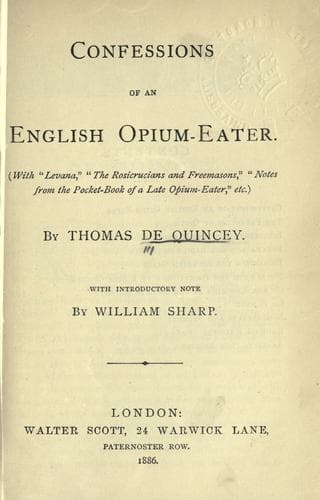
Note Book of an English Opium-EaterDe Quincey, Thomas
Philosophy
Note Book of an English Opium-Eater
De Quincey, Thomas
Opium abuse -- England
But then, again, whatever change in the music were made, so as to 'better
the condition' of the poor audience, something should really be done to
'better the condition' of the poor chorus. Think of these worthy men, in
their white and skyblue liveries, kept standing the whole evening; no
seats allowed, no dancing; no tobacco; nothing to console them but
Antigone's beauty; and all this in our climate, latitude fifty-five
degrees, 30th of December, and Fahrenheit groping about, I don't pretend
to know where, but clearly on his road down to the wine cellar. Mr.
Murray, I am perfectly sure, is too liberal to have grudged the expense,
if he could have found any classic precedent for treating the chorus to a
barrel of ale. Ale, he may object, is an unclassical tipple; but perhaps
not. Xenophon, the most Attic of prose writers, mentions pointedly in his
_Anabasis_, that the Ten Thousand, when retreating through snowy
mountains, and in circumstances very like our General Elphinstone's
retreat from Cabul, came upon a considerable stock of bottled ale. To be
sure, the poor ignorant man calls it _barley wine_, [Greek: _oitos
chrithinos_:] but the flavor was found so perfectly classical that not
one man of the ten thousand, not even the Attic bee himself, is reported
to have left any protest against it, or indeed to have left much of the
ale.
But stop: perhaps I am intruding upon other men's space. Speaking,
therefore, now finally to the principal question, How far did this
memorable experiment succeed? I reply, that, in the sense of realizing all
that the joint revivers proposed to realize, it succeeded; and failed only
where these revivers had themselves failed to comprehend the magnificent
tendencies of Greek tragedy, or where the limitations of our theatres,
arising out of our habits and social differences, had made it impossible
to succeed. In London, I believe that there are nearly thirty theatres,
and many more, if every place of amusement (not bearing the technical name
of _theatre_) were included. All these must be united to compose a
building such as that which received the vast audiences, and consequently
the vast spectacles, of some ancient cities. And yet, from a great mistake
in our London and Edinburgh attempts to imitate the stage of the Greek
theatres, little use was made of such advantages as really _were_ at
our disposal. The possible depth of the Edinburgh stage was not laid open.
Instead of a regal hall in Thebes, I protest I took it for the boudoir of
Antigone. It was painted in light colors, an error which was abominable,
though possibly meant by the artist (but quite unnecessarily) as a proper
ground for relieving the sumptuous dresses of the leading performers. The
doors of entrance and exit were most unhappily managed. As to the dresses,
those of Creon, of his queen, and of the two loyal sisters, were good:
chaste, and yet princely. The dress of the chorus was as bad as bad as
Public-domain text, read in full here on John Shaqi.
Reviews
Reviews
No reviews yet
Be the first to share your thoughts on this work.
Elsewhere in the archive
Join the Discussion
Join the discussion
Sign in to leave a comment or review.
Sign InorCreate an account