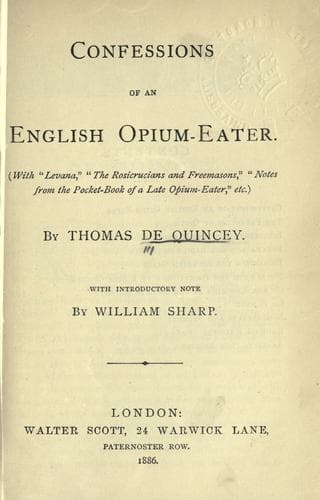
Note Book of an English Opium-EaterDe Quincey, Thomas
Philosophy
Note Book of an English Opium-Eater
De Quincey, Thomas
Opium abuse -- England
could be: a few surplices borrowed from Episcopal chapels, or rather the
ornamented _albes_, &c. from any rich Roman Catholic establishment,
would have been more effective. The _Coryphaeus_ himself seemed, to
my eyes, no better than a railway laborer, fresh from tunnelling or
boring, and wearing a _blouse_ to hide his working dress. These ill-
used men ought to 'strike' for better clothes, in case Antigone should
again revisit the glimpses of an Edinburgh moon; and at the same time they
might mutter a hint about the ale. But the great hindrances to a perfect
restoration of a Greek tragedy, lie in peculiarities of our theatres that
cannot be removed, because bound up with their purposes. I suppose that
Salisbury Plain would seem too vast a theatre: but at least a cathedral
would be required in dimensions, York Minster or Cologne. Lamp-light gives
to us some advantages which the ancients had not. But much art would be
required to train and organize the lights and the masses of superincumbent
gloom, that should be such as to allow no calculation of the dimensions
overhead. Aboriginal night should brood over the scene, and the sweeping
movements of the scenic groups: bodily expression should be given to the
obscure feeling of that dark power which moved in ancient tragedy: and we
should be made to know why it is that, with the one exception of the
_Persae_, founded on the second Persian invasion, [11] in which
Aeschylus, the author, was personally a combatant, and therefore a
_contemporary_, not one of the thirty-four Greek tragedies surviving,
but recedes into the dusky shades of the heroic, or even fabulous times.
A failure, therefore, I think the 'Antigone,' in relation to an object
that for us is unattainable; but a failure worth more than many ordinary
successes. We are all deeply indebted to Mr. Murray's liberality, in two
senses; to his liberal interest in the noblest section of ancient
literature, and to his liberal disregard of expense. To have seen a
Grecian play is a great remembrance. To have seen Miss Helen Faucit's
Antigone, were _that_ all, with her bust, [Greek: _os agalmatos_] [12] and
her uplifted arm 'pleading against unjust tribunals,' is worth--what is it
worth? Worth the money? How mean a thought! To see _Helen_, to see Helen
of Greece, was the chief prayer of Marlow's Dr. Faustus; the chief gift
which he exacted from the fiend. To see Helen of Greece? Dr. Faustus, we
_have_ seen her: Mr. Murray is the Mephistopheles that showed her to us.
It was cheap at the price of a journey to Siberia, and is the next best
thing to having seen Waterloo at sunset on the 18th of June, 1815. [13]
FOOTNOTES
[1] '_When sown_;' as it has been repeatedly; a fact which some
readers may not be aware of.
[2] Boileau, it is true, translated Longinus. But there goes little Greek
to _that_. It is in dealing with Attic Greek, and Attic _poets_,
that a man can manifest his Grecian skill.
[3] 'Before God was known;'--i.e. known in Greece.
Public-domain text, read in full here on John Shaqi.
Reviews
Reviews
No reviews yet
Be the first to share your thoughts on this work.
Elsewhere in the archive
Join the Discussion
Join the discussion
Sign in to leave a comment or review.
Sign InorCreate an account