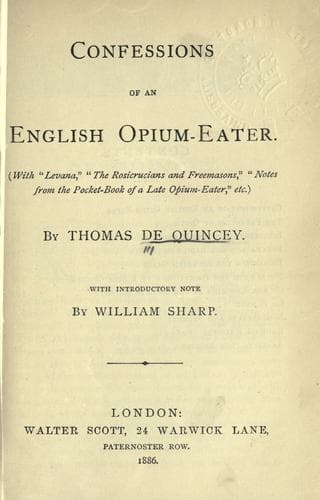
Note Book of an English Opium-EaterDe Quincey, Thomas
Philosophy
Note Book of an English Opium-Eater
De Quincey, Thomas
Opium abuse -- England
never exerted it capriciously, or even showed it at all conspiciously.
According to the testimony of all the neighbors, she treated her mistress
with a shade of unobtrusive respect on the one hand, and yet was eager to
relieve her, whenever that was possible, from the weight of her maternal
duties, with the cheerful voluntary service of a sister.
To this young woman it was, that, suddenly, within three or four minutes
of midnight, Marr called aloud from the head of the stairs--directing her
to go out and purchase some oysters for the family supper. Upon what
slender accidents hang oftentimes solemn lifelong results! Marr occupied
in the concerns of his shop, Mrs. Marr occupied with some little ailment
and restlessness of her baby, had both forgotten the affair of supper; the
time was now narrowing every moment, as regarded any variety of choice;
and oysters were perhaps ordered as the likeliest article to be had at
all, after twelve o'clock should have struck. And yet, upon this trivial
circumstance depended Mary's life. Had she been sent abroad for supper at
the ordinary time of ten or eleven o'clock, it is almost certain that she,
the solitary member of the household who escaped from the exterminating
tragedy, would _not_ have escaped; too surely she would have shared
the general fate. It had now become necessary to be quick. Hastily,
therefore, receiving money from Marr with a basket in her hand, but
unbonneted, Mary tripped out of the shop. It became afterwards, on
recollection, a heart-chilling remembrance to herself--that, precisely as
she emerged from the shop-door, she noticed, on the opposite side of the
street, by the light of the lamps, a man's figure; stationary at the
instant, but in the next instant slowly moving. This was Williams; as a
little incident, either just before or just after (at present it is
impossible to say which), sufficiently proved. Now, when one considers the
inevitable hurry and trepidation of Mary under the circumstances stated,
time barely sufficing for any chance of executing her errand, it becomes
evident that she must have connected some deep feeling of mysterious
uneasiness with the movements of this unknown man; else, assuredly, she
would not have found her attention disposable for such a case. Thus far,
she herself threw some little light upon what it might be that, semi-
consciously, was then passing through her mind; she said, that,
notwithstanding the darkness, which would not permit her to trace the
man's features, or to ascertain the exact direction of his eyes, it yet
struck her, that from his carriage when in motion, and from the apparent
inclination of his person, he must be looking at No. 29.
Public-domain text, read in full here on John Shaqi.
Reviews
Reviews
No reviews yet
Be the first to share your thoughts on this work.
Join the Discussion
Join the discussion
Sign in to leave a comment or review.
Sign InorCreate an account