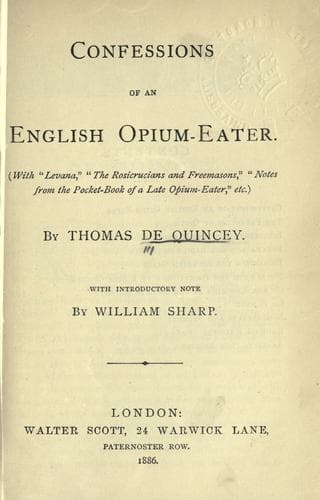
Note Book of an English Opium-EaterDe Quincey, Thomas
Philosophy
Note Book of an English Opium-Eater
De Quincey, Thomas
Opium abuse -- England
[9] _Whose_ version, I do not know. But one unaccountable error was
forced on one's notice. _Thebes_, which, by Milton and by every scholar is
made a monosyllable, is here made a dissyllable. But _Thebez_, the
dissyllable, is a _Syrian_ city. It is true that Causabon deduces from a
Syriac word meaning a case or enclosure (a _theca_), the name of Thebes,
whether Boeotian or Egyptian. It is probable, therefore, that Thebes the
hundred-gated of Upper Egypt, Thebes the seven-gated of Greece, and Thebes
of Syria, had all one origin as regards the name. But this matters not; it
is the _English_ name that we are concerned with.
[10] '_False_:' or rather inaccurate. The burlesque was not on the
Antigone, but on the Medea of Euripides; and very amusing.
[11] But in this instance, perhaps, distance of space, combined with the
unrivalled grandeur of the war, was felt to equiponderate the distance of
time, Susa, the Persian capital, being fourteen hundred miles from Athens.
[12] _[Greek: Sterna th'os agalmatos], her bosom as the bosom of a
statue_; an expression of Euripides, and applied, I think, to Polyxena
at the moment of her sacrifice on the tomb of Achilles, as the bride that
was being married to him at the moment of his death.
[13] Amongst the questions which occurred to me as requiring an answer, in
connection with this revival, was one with regard to the comparative
fitness of the Antigone for giving a representative idea of the Greek
stage. I am of opinion that it was the worst choice which could have been
made; and for the very reason which no doubt governed that choice, viz.--
because the austerity of the tragic passion is disfigured by a love
episode. Rousseau in his letter to D'Alembert upon his article _Geneve_,
in the French Encyclopedie, asks,--'_Qui est-ce qui doute que, sur nos
theatres, la meilleure piece de Sophocle ne tombat tout-a-plat?_' And his
reason (as collected from other passages) is--because an interest derived
from the passion of sexual love can rarely be found on the Greek stage,
and yet cannot be dispensed with on that of Paris. But why was it so rare
on the Greek stage? Not from accident, but because it did not harmonize
with the principle of that stage, and its vast overhanging gloom. It is
the great infirmity of the French, and connected constitutionally with the
gayety of their temperament, that they cannot sympathize with this
terrific mode of grandeur. We can. And for _us_ the choice should have
been more purely and severely Grecian; whilst the slenderness of the plot
in any Greek tragedy, would require a far more effective support from
tumultuous movement in the chorus. Even the French are not uniformly
insensible to this Grecian grandeur. I remember that Voltaire, amongst
many just remarks on the Electra of Sophocles, mixed with others that are
_not_ just, bitterly condemns this demand for a love fable on the French
stage, and illustrates its extravagance by the French tragedy on the same
Public-domain text, read in full here on John Shaqi.
Reviews
Reviews
No reviews yet
Be the first to share your thoughts on this work.
Elsewhere in the archive
Join the Discussion
Join the discussion
Sign in to leave a comment or review.
Sign InorCreate an account