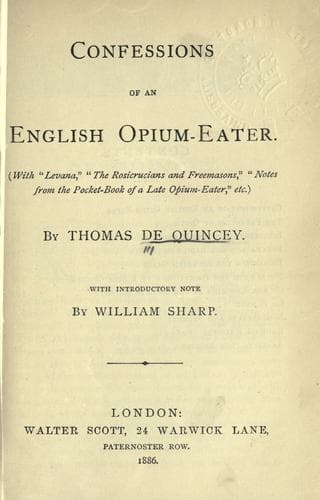
Note Book of an English Opium-EaterDe Quincey, Thomas
Philosophy
Note Book of an English Opium-Eater
De Quincey, Thomas
Opium abuse -- England
[4] At times, I say pointedly, the _Athenian_ rather than the
_Grecian_ tragedy, in order to keep the reader's attention awake to a
remark made by Paterculus,--viz. That although Greece coquettishly
welcomed homage to herself, as generally concerned in the Greek
literature, in reality Athens only had any original share in the drama, or
in the oratory of Greece.
[5] '_The supreme artist_:'--It is chiefly by comparison with Euripides,
that Sophocles is usually crowned with the laurels of _art_. But there is
some danger of doing wrong to the truth in too blindly adhering to these
old rulings of critical courts. The judgments would sometimes be reversed,
if the pleadings were before us. There were blockheads in those days.
Undoubtedly it is past denying that Euripides at times betrays marks of
carelessness in the structure of his plots, as if writing too much in a
hurry: the original cast of the fable is sometimes not happy, and the
evolution or disentangling is too precipitate. It is easy to see that he
would have remoulded them in a revised edition, or _diaskeue [Greek.]_ On
the other hand, I remember nothing in the Greek drama more worthy of a
great artist than parts in his Phoenissae. Neither is he the effeminately
tender, or merely pathetic poet that some people imagine. He was able to
sweep _all_ the chords of the impassioned spirit. But the whole of this
subject is in arrear: it is in fact _res integra_, almost unbroken ground.
[6] I see a possible screw loose at this point: if _you_ see it, reader,
have the goodness to hold your tongue.
[7] '_Athenian Theatre_:'--Many corrections remain to be made. Athens, in
her bloom, was about as big as Calcutta, which contained, forty years ago,
more than half a million of people; or as Naples, which (being long rated
at three hundred thousand), is now known to contain at least two hundred
thousand more. The well known census of Demetrius Phalereus gave twenty-
one thousand citizens. Multiply this by 5, or 4-3/4, and you have their
families. Add ten thousand, multiplied by 4-1/2, for the _Inquilini_. Then
add four hundred thousand for the slaves: total, about five hundred and
fifty thousand. But upon the fluctuations of the Athenian population there
is much room for speculation. And, quaere, was not the population of
Athens greater two centuries before Demetrius, in the days of Pericles?
[8] Having no Sophocles at hand, I quote from memory, not pretending
therefore to exactness: but the sense is what I state.
Public-domain text, read in full here on John Shaqi.
Reviews
Reviews
No reviews yet
Be the first to share your thoughts on this work.
Elsewhere in the archive
Join the Discussion
Join the discussion
Sign in to leave a comment or review.
Sign InorCreate an account