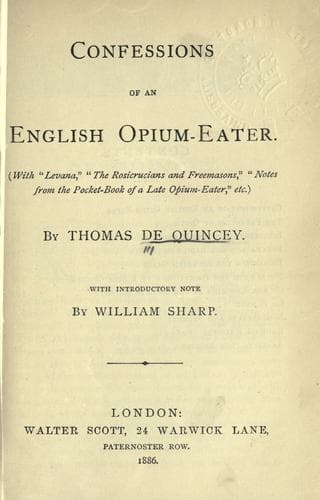
Note Book of an English Opium-EaterDe Quincey, Thomas
Philosophy
Note Book of an English Opium-Eater
De Quincey, Thomas
Opium abuse -- England
recorded, that he was the father of Wellerand de Wellesley. And what did
young Mr. Wellerand perform in this wicked world, that the proud muse of
history should condescend to notice his rather singular name? Reader, he
was--'killed:' that is all; and in company with Sir Robert de Percival;
which again argues his Somersetshire descent: for the family of Lord
Egmont, the head of all Percivals, ever was, and ever will be, in
Somersetshire. But _how_ was he killed? The time _when_, viz. 1303, the
place _where_, are known: but the manner _how_, is not exactly stated; it
was in skirmish with rascally Irish 'kernes,' fellows that (when presented
at the font of Christ for baptism) had their right arms covered up from
the baptismal waters, in order that, still remaining consecrated to the
devil, those arms might inflict a devilish blow. Such a blow, with such an
unbaptized arm, the Irish villain struck; and there was an end of
Wellerand de Wellesleigh. Strange that history should make an end of a
man, before it had made a beginning of him. These, however, are the
_facts_; which, in writing a romance about Sir Wellerand and Sir
Percival, I shall have great pleasure in falsifying. But how, says the too
curious reader, did the De Wellesleighs find themselves amongst Irish
kernes? Had these scamps the presumption to invade Somersetshire? Did they
dare to intrude into Wells? Not at all: but the pugnacious De Wellesleys
had dared to intrude into Ireland. Some say in the train of Henry II. Some
say--but no matter: _there_ they were: and _there_ they stuck like
limpets. They soon engrafted themselves into the county of Kildare;
from which, by means of a fortunate marriage, they leaped into the county
of Meath; and in that county, as if to refute the pretended mutability of
human things, they have roosted ever since. There was once a famous copy
of verses floating about Europe, which asserted that, whilst other princes
were destined to fight for thrones, Austria--the handsome house of
Hapsburgh--should obtain them by marriage:
'Pugnabunt alii: tu, felix Austria, nube.'
Public-domain text, read in full here on John Shaqi.
Reviews
Reviews
No reviews yet
Be the first to share your thoughts on this work.
Elsewhere in the archive
Join the Discussion
Join the discussion
Sign in to leave a comment or review.
Sign InorCreate an account