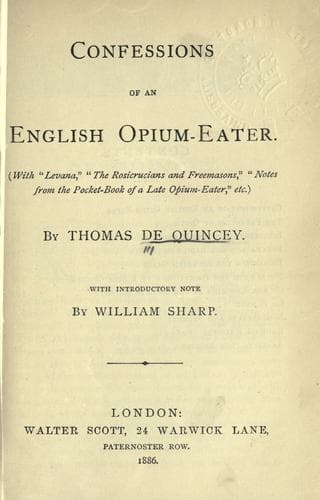
Note Book of an English Opium-EaterDe Quincey, Thomas
Philosophy
Note Book of an English Opium-Eater
De Quincey, Thomas
Opium abuse -- England
So of the Wellesleys: Sir Wellerand took quite the wrong way: not
cudgelling, but courting, was the correct way for succeeding in Kildare.
Two great estates, by two separate marriages, the De Wellesleighs obtained
in Kildare; and, by a third marriage in a third generation, they obtained
in the county of Meath, Castle Dengan (otherwise Dangan) with lordships as
plentiful as blackberries. Castle Dangan came to them in the year of our
Lord, 1411, _i.e._ before Agincourt: and, in Castle Dangan did Field-
marshal, the man of Waterloo, draw his first breath, shed his first tears,
and perpetrate his earliest trespasses. That is what one might call a
pretty long spell for one family: four hundred and thirty-five years has
Castle Dangan furnished a nursery for the Wellesley piccaninnies. Amongst
the lordships attached to Castle Dangan was _Mornington_, which more
than three centuries afterwards supplied an earldom for the grandfather of
Waterloo. Any further memorabilia of the Castle Dangan family are not
recorded, except that in 1485 (which sure was the year of Bosworth field?)
they began to omit the _de_ and to write themselves Wellesley _tout
court_. From indolence, I presume: for a certain lady Di. le Fl., whom
once I knew, a Howard by birth, of the house of Suffolk, told me as her
reason for omitting the _Le_, that it caused her too much additional
trouble.
So far the evidence seems in favor of Wellesley and against Wesley. But,
on the other hand, during the last three centuries the Wellesleys wrote
the name Wesley. They, however, were only the _maternal_ ancestors of
the present Wellesleys. Garret Wellesley, the last male heir of the direct
line, in the year 1745, left his whole estate to one of the Cowleys, a
Staffordshire family who had emigrated to Ireland in Queen Elizabeth's
time, but who were, however, descended from the Wellesleys. This Cowley or
Colley, taking, in 1745, the name of Wesley, received from George II. the
title of Earl Mornington: and Colley's grandson, the Marquess Wellesley of
our age, was recorded in the Irish peerage as _Wesley_, Earl of
Mornington; was uniformly so described up to the end of the eighteenth
century; and even Arthur of Waterloo, whom most of us Europeans know
pretty well, on going to India a little before his brother, was thus
introduced by Lord Cornwallis to Sir John Shore (Lord Teignmouth, the
Governor-general), 'Dear sir, I beg leave to introduce to you Colonel
Wesley, who is a lieutenant-colonel of my regiment. He is a sensible man,
and a good officer.' Posterity, for _we_ are posterity in respect of
Lord Cornwallis, have been very much of _his_ opinion. Colonel Wesley
really _is_ a sensible man; and the sensible man, soon after his
arrival in Bengal, under the instigation of his brother, resumed the old
name of Wellesley. In reality, the name of Wesley was merely the
abbreviation of indolence, as Chumley for Cholmondeley, Pomfret for
Public-domain text, read in full here on John Shaqi.
Reviews
Reviews
No reviews yet
Be the first to share your thoughts on this work.
Elsewhere in the archive
Join the Discussion
Join the discussion
Sign in to leave a comment or review.
Sign InorCreate an account