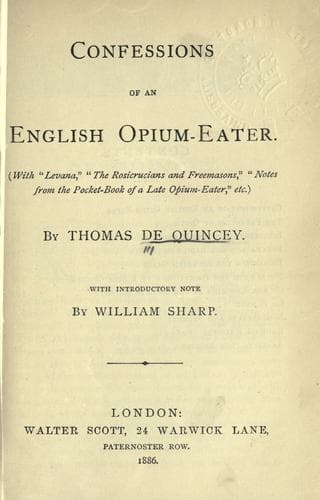
Note Book of an English Opium-EaterDe Quincey, Thomas
Philosophy
Note Book of an English Opium-Eater
De Quincey, Thomas
Opium abuse -- England
claims of the Irish Catholics, his policy was pretty uniformly that of Mr.
Pitt. He supported that minister throughout the contests on the French
Revolution; and a little earlier, on the Regency question. This came
forward in 1788, on occasion of the first insanity which attacked George
III. The reader, who is likely to have been born since that era, will
perhaps not be acquainted with the constitutional question then at issue.
It was this: Mr. Fox held that, upon any incapacity arising in the
sovereign, the regency would then settle (_ipso facto_ of that incapacity)
upon the Prince of Wales; overlooking altogether the case in which there
should _be_ no Prince of Wales, and the case in which such a Prince might
be as incapable, from youth, of exercising the powers attached to the
office, as his father from disease. Mr. Pitt denied that a Prince of Wales
simply _as_ such, and apart from any moral fitness which he might possess,
had more title to the office of regent than any lamp-lighter or scavenger.
It was the province of Parliament exclusively to legislate for the
particular case. The practical decision of the question was not called
for, from the accident of the king's sudden recovery: but in Ireland, from
the independence asserted by the two houses of the British council, the
question grew still more complex. The Lord Lieutenant refused to transmit
their address, [3] and Lord Mornington supported him powerfully in his
refusal.
Ten years after this hot collision of parties, Lord Mornington was
appointed Governor-General of India, and now first he entered upon a stage
worthy of his powers. I cannot myself agree with Mr. Pearce, that 'the
wisdom of his policy is now universally recognized;' because the same
false views of our Indian position, which at that time caused his splendid
services to be slighted in many quarters, still preponderates. All
administrations alike have been intensely ignorant of Indian politics; and
for the natural reason, that the business of home politics leaves them no
disposable energies for affairs so distant, and with which each man's
chance of any durable connection is so exceedingly small. What Lord
Mornington did was this: he looked our prospects in the face. Two great
enemies were then looming upon the horizon, both ignorant of our real
resources, and both deluded by our imperfect use of such resources, as,
even in a previous war, we had possessed. One of these enemies was Tippoo,
the Sultan of Mysore: him, by the crushing energy of his arrangements,
Lord Mornington was able utterly to destroy, and to distribute his
dominions with equity and moderation, yet so as to prevent any new
coalition arising in that quarter against the British power. There is a
portrait of Tippoo, of this very ger, in the second volume of Mr. Pearce's
work, which expresses sufficiently the unparalleled ferocity of his
nature; and it is guaranteed, by its origin, as authentic. Tippoo, from
Public-domain text, read in full here on John Shaqi.
Reviews
Reviews
No reviews yet
Be the first to share your thoughts on this work.
Elsewhere in the archive
Join the Discussion
Join the discussion
Sign in to leave a comment or review.
Sign InorCreate an account