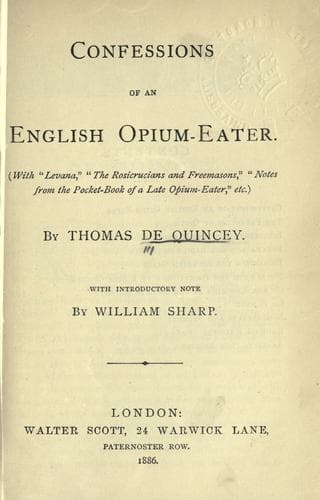
Note Book of an English Opium-EaterDe Quincey, Thomas
Philosophy
Note Book of an English Opium-Eater
De Quincey, Thomas
Opium abuse -- England
Pontefract, Cicester for Cirencester; or, in Scotland, Marchbanks for
Majoribanks, Chatorow for the Duke of Hamilton's French title of
Chatelherault. I remember myself, in childhood, to have met a niece of
John Wesley the Proto-Methodist, who always spoke of the, second Lord
Mornington (author of the well-known glees) as a cousin, and as intimately
connected with her brother the great _foudroyant_ performer on the
organ. Southey, in his Life of John Wesley, tells us that Charles Wesley,
the brother of John, and father of the great organist, had the offer from
Garret Wellesley of those same estates which eventually were left to
Richard Cowley. This argues a recognition of near consanguinity. Why the
offer was declined, is not distinctly explained. But if it had been
accepted, Southey thinks that then we should have had no storming of
Seringapatam, no Waterloo, and no Arminian Methodists. All that is not
quite clear. Tippoo was booked for a desperate British vengeance by his
own desperate enmity to our name, though no Lord Wellesley had been
Governor-General. Napoleon, by the same fury of hatred to us, was booked
for the same fate, though the scene of it might not have been Waterloo.
And, as to John Wesley, why should he not have made the same schism with
the English Church, because his brother Charles had become unexpectedly
rich?
The Marquess Wellesley was of the same standing, as to age, or nearly so,
as Mr. Pitt; though he outlived Pitt by almost forty years. Born in 1760,
three or four months before the accession of George III., he was sent to
Eton, at the age of eleven; and from Eton, in his eighteenth year, he was
sent to Christ Church, Oxford, where he matriculated as a nobleman. He
then bore the courtesy title of Viscount Wellesley; but in 1781, when he
had reached his twenty-first year, he was summoned away from Oxford by the
death of his father, the second Earl of Mornington. It is interesting, at
this moment, to look back on the family group of children collected at
Dangan Castle. The young earl was within a month of his majority: his
younger brothers and sisters were, William Wellesley Pole (since dead,
under the title of Lord Maryborough), then aged eighteen; Anne, since
married to Henry, son of Lord Southampton, aged thirteen; Arthur, aged
twelve; Gerald Valerian, now in the church, aged ten; Mary Elizabeth
(since Lady Culling Smith), aged nine; Henry, since Lord Cowley, and
British ambassador to Spain, France, &c. aged eight. The new Lord
Mornington showed his conscientious nature, by assuming his father's
debts, and by superintending the education of his brothers. He had
distinguished himself at Oxford as a scholar; but he returned thither no
more, and took no degree. As Earl of Mornington, he sat in the Irish House
of Lords; but not being a British peer, he was able to sit also in the
English House of Commons; and of this opening for a more national career,
he availed himself at the age of twenty-four. Except that he favored the
Public-domain text, read in full here on John Shaqi.
Reviews
Reviews
No reviews yet
Be the first to share your thoughts on this work.
Elsewhere in the archive
Join the Discussion
Join the discussion
Sign in to leave a comment or review.
Sign InorCreate an account