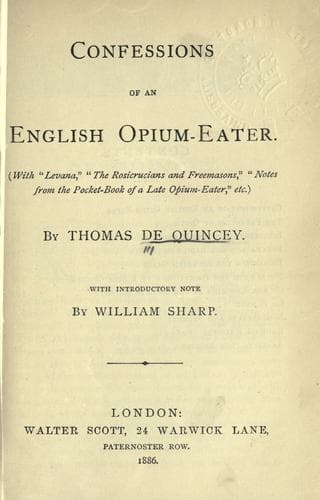
Note Book of an English Opium-EaterDe Quincey, Thomas
Philosophy
Note Book of an English Opium-Eater
De Quincey, Thomas
Opium abuse -- England
Something remains to be said of Lord Wellesley as a literary man; and
towards such a judgment Mr. Pearce has contributed some very pleasing
materials. As a public speaker, Lord Wellesley had that degree of
brilliancy and effectual vigor, which might have been expected in a man of
great talents, possessing much native sensibility to the charms of style,
but not led by any personal accidents of life into a separate cultivation
of oratory, or into any profound investigation of its duties and its
powers on the arena of a British senate. There is less call for speaking
of Lord Wellesley in this character, where he did not seek for any eminent
distinction, than in the more general character of an elegant
_litterateur_, which furnished to him much of his recreation in all
stages of his life, and much of his consolation in the last. It is
interesting to see this accomplished nobleman, in advanced age, when other
resources were one by one decaying, and the lights of life were
successively fading into darkness, still cheering his languid hours by the
culture of classical literature, and in his eighty-second year drawing
solace from those same pursuits which had given grace and distinction to
his twentieth.
One or two remarks I will make upon Lord Wellesley's verses--Greek as well
as Latin. The Latin lines upon Chantrey's success at Holkham in killing
two woodcocks at the first shot, which subsequently he sculptured in
marble and presented to Lord Leicester, are perhaps the most felicitous
amongst the whole. Masquerading, in Lord Wellesley's verses, as
Praxiteles, who could not well be represented with a Manon having a
percussion lock, Chantrey is armed with a bow and arrows:
'En! trajecit aves una sagitta duas.'
In the Greek translation of _Parthenopaeus_, there are as few faults
as could reasonably be expected. But, first, one word as to the original
Latin poem: to whom does it belong? It is traced first to Lord Grenville,
who received it from his tutor (afterwards Bishop of London), who had
taken it as an anonymous poem from the 'Censor's book;' and with very
little probability, it is doubtfully assigned to 'Lewis of the War
Office,' meaning, no doubt, the father of Monk Lewis. By this anxiety in
tracing its pedigree, the reader is led to exaggerate the pretensions of
the little poem; these are inconsiderable: and there is a conspicuous
fault, which it is worth while noticing, because it is one peculiarly
besetting those who write modern verses with the help of a gradus, viz.
that the Pentameter is often a mere reverberation of the preceding
Hexameter. Thus, for instance--
'Parthenios inter saltus non amplius erro,
Non repeto Dryadum pascua laeta choris;'
Public-domain text, read in full here on John Shaqi.
Reviews
Reviews
No reviews yet
Be the first to share your thoughts on this work.
Elsewhere in the archive
Join the Discussion
Join the discussion
Sign in to leave a comment or review.
Sign InorCreate an account