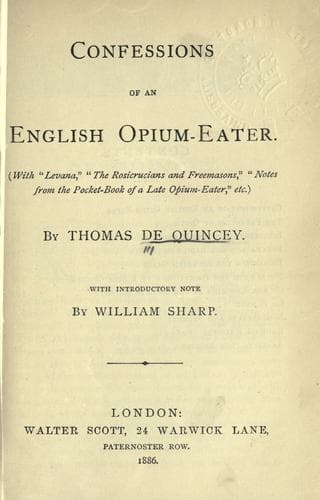
Note Book of an English Opium-EaterDe Quincey, Thomas
Philosophy
Note Book of an English Opium-Eater
De Quincey, Thomas
Opium abuse -- England
and so of others, where the second line is but a variation of the first.
Even Ovid, with all his fertility, and partly in consequence of his
fertility, too often commits this fault. Where indeed the thought is
effectually varied, so that the second line acts as a musical _minor_,
succeeding to the _major_, in the first, there may happen to arise a
peculiar beauty. But I speak of the ordinary case, where the second is
merely the rebound of the first, presenting the same thought in a diluted
form. This is the commonest resource of feeble thinking, and is also a
standing temptation or snare for feeble thinking. Lord Wellesley, however,
is not answerable for these faults in the original, which indeed he
notices slightly as 'repetitions;' and his own Greek version is spirited
and good. There, are, however, some mistakes. The second line is
altogether faulty;
[Greek: _Choria Mainaliph pant erateina theph
Achnumenos leipon_]
does not express the sense intended. Construed correctly, this clause of
the sentence would mean--'_I, sorrowfully leaving all places gracious to
the Maenalian god_:' but _that_ is not what Lord Wellesley designed: '_I
leaving the woods of Cyllene, and the snowy summits of Pholoe, places that
are all of them dear to Pan_'--_that_ is what was meant: that is to say,
not _leaving all places dear to Pan_, far from it; but _leaving a few
places, every one of which is dear to Pan_. In the line beginning
[Greek: _Kan eth uph aelikias_]
where the meaning is--_and if as yet, by reason of my immature age_,
there is a metrical error; and [Greek: _aelikia_] will not express
immaturity of age. I doubt whether in the next line,
[Greek: _Maed alkae thalloi gounasin aeitheos_]
[Greek: _gounasin_] could convey the meaning without the preposition
[Greek: _eth_]. And in
[Greek: _Spherchomai ou kaleousi theoi._]
_I hasten whither the gods summon me_--[Greek: _ou_] is not the right
word. It is, however, almost impossible to write Greek verses which
shall be liable to no verbal objections; and the fluent movement of these
verses sufficiently argues the off-hand ease with which Lord Wellesley
must have _read_ Greek, writing it so elegantly and with so little of
apparent constraint.
Meantime the most interesting (from its circumstances) of Lord Wellesley's
verses, is one to which his own English interpretation of it has done less
than justice. It is a Latin epitaph on the daughter (an only child) of
Lord and Lady Brougham. She died, and (as was generally known at the time)
of an organic affection disturbing the action of the heart, at the early
age of eighteen. And the peculiar interest of the case lies in the
suppression by this pious daughter (so far as it was possible) of her own
bodily anguish, in order to beguile the mental anguish of her parents. The
Latin epitaph is this:
Public-domain text, read in full here on John Shaqi.
Reviews
Reviews
No reviews yet
Be the first to share your thoughts on this work.
Elsewhere in the archive
Join the Discussion
Join the discussion
Sign in to leave a comment or review.
Sign InorCreate an account