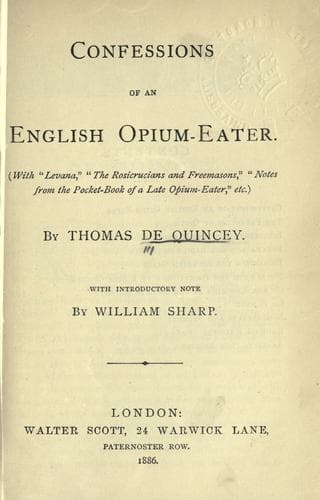
Note Book of an English Opium-EaterDe Quincey, Thomas
Philosophy
Note Book of an English Opium-Eater
De Quincey, Thomas
Opium abuse -- England
This conversation is doubly interesting: interesting by its subject,
interesting by its interlocutors; for the subject is Milton, whilst the
interlocutors are _Southey_ and _Landor_. If a British gentleman, when
taking his pleasure in his well-armed yacht, descries, in some foreign
waters, a noble vessel, from the Thames or the Clyde, riding peaceably at
anchor--and soon after, two smart-looking clippers, with rakish masts,
bearing down upon her in company--he slackens sail: his suspicions are
slightly raised; they have not shown their teeth as yet, and perhaps all
is right; but there can be no harm in looking a little closer; and,
assuredly, if he finds any mischief in the wind against his countryman, he
will show _his_ teeth also; and, please the wind, will take up such a
position as to rake both of these pirates by turns. The two dialogists are
introduced walking out after breakfast, 'each his Milton in his pocket;'
and says Southey, 'Let us collect all the graver faults we can lay our
hands upon, without a too minute and troublesome research;'--just so;
there would be danger in _that_--help might put off from shore;--'not,'
says he, 'in the spirit of Johnson, but in our own.' Johnson we may
suppose, is some old ruffian well known upon that coast; and '_faults_'
may be a flash term for what the Americans call 'notions.' A part of the
cargo it clearly is; and one is not surprised to hear Landor, whilst
assenting to the general plan of attack, suggesting in a whisper 'that
they should abase their eyes in reverence to so great a man, without
absolutely closing them;' which I take to mean--that, without trusting
entirely to their boarders, or absolutely closing their ports, they should
depress their guns and fire down into the hold, in respect of the vessel
attacked standing so high out of the water. After such plain speaking,
nobody can wonder much at the junior pirate (Landor) muttering, 'It will
be difficult for us always to refrain.' Of course it will: _refraining_
was no part of the business, I should fancy, taught by that same
buccaneer, Johnson. There is mischief, you see, reader, singing in the
air--'miching malhecho'--and it is our business to watch it.
Public-domain text, read in full here on John Shaqi.
Reviews
Reviews
No reviews yet
Be the first to share your thoughts on this work.
Elsewhere in the archive
Join the Discussion
Join the discussion
Sign in to leave a comment or review.
Sign InorCreate an account