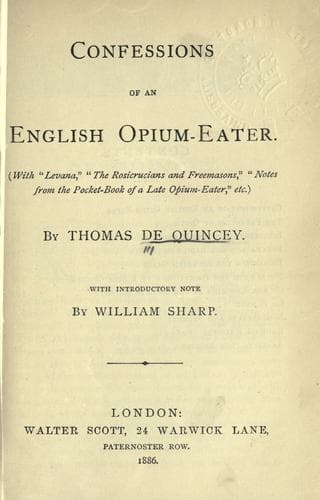
Note Book of an English Opium-EaterDe Quincey, Thomas
Philosophy
Note Book of an English Opium-Eater
De Quincey, Thomas
Opium abuse -- England
But, before coming to the main attack, I must suffer myself to be detained
for a few moments by what Mr. L. premises upon the 'moral' of any great
fable, and the relation which it bears, or _should_ bear, to the solution
of such a fable. Philosophic criticism is so far improved, that, at this
day, few people, who have reflected at all upon such subjects, but are
agreed as to one point: viz., that in metaphysical language the moral
of an epos or a drama should be _immanent_, not _transient_; or,
otherwise, that it should be vitally distributed through the whole
organization of the tree, not gathered or secreted into a sort of red
berry or _racemus_, pendent at the end of its boughs. This view Mr. Landor
himself takes, as a general view; but, strange to say, by some Landorian
perverseness, where there occurs a memorable exception to this rule (as in
the 'Paradise Lost'), in that case he insists upon the rule in its rigor--
the rule, and nothing _but_ the rule. Where, on the contrary, the rule
does really and obviously take effect (as in the 'Iliad' and 'Odyssey'),
there he insists upon an exceptional case. There _is_ a moral, in _his_
opinion, hanging like a tassel of gold bullion from the 'Iliad;'--and what
is it? Something so fantastic, that I decline to repeat it. As well might
he have said, that the moral of 'Othello' was--'_Try Warren's Blacking!_'
There is no moral, little or big, foul or fair, to the 'Iliad.' Up to the
17th book, the moral might seem dimly to be this--'Gentlemen, keep the
peace: you see what comes of quarrelling.' But _there_ this moral ceases;
--there is now a break of guage: the narrow guage takes place after this;
whilst up to this point, the broad guage--viz., the wrath of Achilles,
growing out of his turn-up with Agamemnon--had carried us smoothly along
without need to shift our luggage. There is no more quarrelling after Book
17, how then can there be any more moral from quarrelling? If you insist
on _my_ telling _you_ what is the moral of the 'Iliad,' I insist upon
_your_ telling _me_ what is the moral of a rattlesnake or the moral of a
Niagara. I suppose the moral is--that you must get out of their way, if
you mean to moralize much longer. The going-up (or anabasis) of the Greeks
against Troy, was a _fact;_ and a pretty dense fact; and, by accident, the
very first in which all Greece had a common interest. It was a joint-stock
concern--a representative expedition--whereas, previously there had been
none; for even the Argonautic expedition, which is rather of the darkest,
implied no confederation except amongst individuals. How could it? For the
Argo is supposed to have measured only twenty-seven tons: how she would
have been classed at Lloyd's is hard to say, but certainly not as A 1.
There was no state-cabin; everybody, demi-gods and all, pigged in the
steerage amongst beans and bacon. Greece was naturally proud of having
crossed the herring-pond, small as it was, in search of an entrenched
Public-domain text, read in full here on John Shaqi.
Reviews
Reviews
No reviews yet
Be the first to share your thoughts on this work.
Elsewhere in the archive
Join the Discussion
Join the discussion
Sign in to leave a comment or review.
Sign InorCreate an account