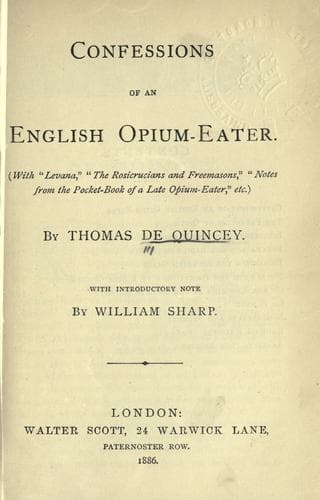
Note Book of an English Opium-EaterDe Quincey, Thomas
Philosophy
Note Book of an English Opium-Eater
De Quincey, Thomas
Opium abuse -- England
enemy; proud also of having licked him 'into Almighty smash;' this was
sufficient; or if an impertinent moralist sought for something more,
doubtless the moral must have lain in the booty. A peach is the moral of a
peach, and moral enough; but if a man _will_ have something better--a
moral within a moral--why, there is the peach-stone, and its kernel, out
of which he may make ratafia, which seems to be the ultimate morality that
_can_ be extracted from a peach. Mr. Archdeacon Williams, indeed, of the
Edinburgh Academy, has published an _octavo_ opinion upon the case, which
asserts that the moral of the Trojan war was (to borrow a phrase from
children) _tit for tat_. It was a case of retaliation for crimes against
Hellas, committed by Troy in an earlier generation. It may be so; Nemesis
knows best. But this moral, if it concerns the total expedition to the
Troad, cannot concern the 'Iliad,' which does not take up matters from so
early a period, nor go on to the final catastrophe of Ilium.
Now, as to the 'Paradise Lost,' it happens that there is--whether there
ought to be or not--a pure golden moral, distinctly announced, separately
contemplated, and the very weightiest ever uttered by man or realized by
fable. It is a moral rather for the drama of a world than for a human
poem. And this moral is made the more prominent and memorable by the
grandeur of its annunciation. The jewel is not more splendid in itself
than in its setting. Excepting the well-known passage on Athenian oratory
in the 'Paradise Regained,' there is none even in Milton where the
metrical pomp is made so effectually to aid the pomp of the sentiment.
Hearken to the way in which a roll of dactyles is made to settle, like the
swell of the advancing tide, into the long thunder of billows breaking for
leagues against the shore:
'That to the height of this great argument
I may assert eternal Providence.'--
Hear what a motion, what a tumult, is given by the dactylic close to each
of the introductory lines! And how massily is the whole locked up into the
peace of heaven, as the aerial arch of a viaduct is locked up into
tranquil stability by its key-stone, through the deep spondaic close,
'And justify the ways of God to man.'
That is the moral of the Miltonic epos; and as much grander than any other
moral _formally_ illustrated by poets, as heaven is higher than earth.
Public-domain text, read in full here on John Shaqi.
Reviews
Reviews
No reviews yet
Be the first to share your thoughts on this work.
Elsewhere in the archive
Join the Discussion
Join the discussion
Sign in to leave a comment or review.
Sign InorCreate an account