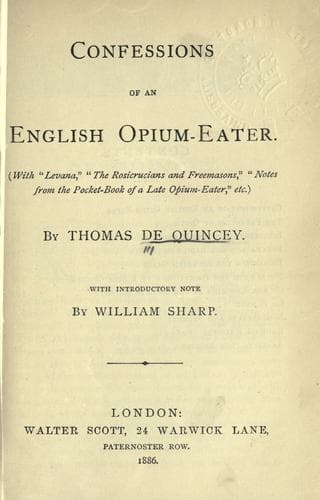
Note Book of an English Opium-EaterDe Quincey, Thomas
Philosophy
Note Book of an English Opium-Eater
De Quincey, Thomas
Opium abuse -- England
by no means in getting into the bottle, but in _not_ getting into it. The
foreign contractor would have been probably a very unhappy man, had he
fulfilled his contract by over-colonizing the bottle, but he would have
been decidedly a more virtuous man. He would have redeemed his pledge;
and, if he had even died in the bottle, we should have honored him as a
'_vir bonus, cum mala fortuna compositus_;' as a man of honor matched in
single duel with calamity, and also as the best of conjurers. Over-
colonization, therefore, except in the one case of the stage-coach, is
apparently no crime; and the offence of King Gebir, in my eyes, remains a
mystery to this day.
What next solicits notice is in the nature of a digression: it is a kind
of parenthesis on Wordsworth.
'_Landor._--When it was a matter of wonder how Keats, who was ignorant of
Greek, could have written his "Hyperion," Shelley, whom envy never
touched, gave as a reason--"because he _was_ a Greek." Wordsworth, being
asked his opinion of the same poem, called it, scoffingly, "a pretty piece
of paganism;" yet he himself, in the best verses he ever wrote--and
beautiful ones they are--reverts to the powerful influence of the "pagan
creed."'
Here are nine lines exactly in the original type. Now, nine tailors are
ranked, by great masters of algebra, as = one man; such is the received
equation; or, as it is expressed, with more liveliness, in an old English
drama, by a man who meets and quarrels with eighteen tailors--'Come, hang
it! I'll fight you _both_.' But, whatever be the algebraic ratio of
tailors to men, it is clear that nine Landorian lines are not always equal
to the delivery of one accurate truth, or to a successful conflict with
three or four signal errors. Firstly--Shelley's reason, if it ever was
assigned, is irrelevant as regards any question that must have been
intended. It could not have been meant to ask--Why was the 'Hyperion' so
Grecian in its spirit? for it is anything but Grecian. We should praise it
falsely to call it so; for the feeble, though elegant, mythology of Greece
was incapable of breeding anything so deep as the mysterious portents
that, in the 'Hyperion,' run before and accompany the passing away of
divine immemorial dynasties. Nothing can be more impressive than the
picture of Saturn in his palsy of affliction, and of the mighty goddess
his grand-daughter, or than the secret signs of coming woe in the palace
of Hyperion. These things grew from darker creeds than Greece had ever
known since the elder traditions of Prometheus--creeds that sent down
their sounding plummets into far deeper wells within the human spirit.
What had been meant, by the question proposed to Shelley, was no doubt--
How so young a man as Keats, not having had the advantage of a regular
classical education, could have been so much at home in the details of the
_elder_ mythology? Tooke's 'Pantheon' might have been obtained by
Public-domain text, read in full here on John Shaqi.
Reviews
Reviews
No reviews yet
Be the first to share your thoughts on this work.
Elsewhere in the archive
Join the Discussion
Join the discussion
Sign in to leave a comment or review.
Sign InorCreate an account