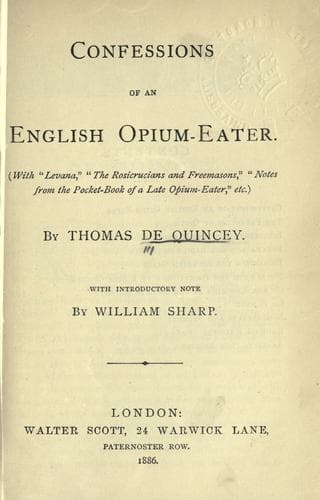
Note Book of an English Opium-EaterDe Quincey, Thomas
Philosophy
Note Book of an English Opium-Eater
De Quincey, Thomas
Opium abuse -- England
favor of any English schoolboy, and Dumoustier's '_Lettres a Emile sur
la Mythologie_' by favor of very many young ladies; but these,
according to my recollection of them, would hardly have sufficed. Spence's
'_Polymetis_,' however, might have been had by favor of any good
library; and the '_Bibliotheca_' of Apollodorus, who is the cock of
the walk on this subject, might have been read by favor of a Latin
translation, supposing Keats really unequal to the easy Greek text. There
is no wonder in the case; nor, if there had been, would Shelley's kind
remark have solved it. The _treatment_ of the facts must, in any
case, have been due to Keats's genius, so as to be the same whether he had
studied Greek or not: the _facts_, apart from the treatment, must in
any case have been had from a book. Secondly--Let Mr. Landor rely upon it
--that Wordsworth never said the thing ascribed to him here as any formal
judgment, or what Scottish law would call _deliverance_, upon the
'Hyperion.' As to what he might have said incidentally and collaterally;
the meaning of words is so entirely affected by their position in a
conversation--what followed, what went before--that five words dislocated
from their context never would be received as evidence in the Queen's
Bench. The court which, of all others, least strictly weighs its rules of
evidence, is the female tea-table; yet even that tribunal would require
the deponent to strengthen his evidence, if he had only five detached
words to produce. Wordsworth is a very proud man as he has good reason to
be; and perhaps it was I myself, who once said in print of him--that it is
not the correct way of speaking, to say that Wordsworth is as proud as
Lucifer; but, inversely, to say of Lucifer that some people have conceived
him to be as proud as Wordsworth. But, if proud, Wordsworth is not
haughty, is not ostentatious, is not anxious for display, is not arrogant,
and, least of all, is he capable of descending to envy. Who or what is it
that _he_ should be envious of? Does anybody suppose that Wordsworth
would be jealous of Archimedes if he now walked upon earth, or Michael
Angelo, or Milton? Nature does not repeat herself. Be assured she will
never make a second Wordsworth. Any of us would be jealous of his own
duplicate; and, if I had a _doppelganger_, who went about personating
me, copying me, and pirating me, philosopher as I am, I might (if the
Court of Chancery would not grant an injunction against him) be so far
carried away by jealousy as to attempt the crime of murder upon his
carcass; and no great matter as regards HIM. But it would be a sad thing
for _me_ to find myself hanged; and for what, I beseech you? for
murdering a sham, that was either nobody at all, or oneself repeated once
too often. But if you show to Wordsworth a man as great as himself, still
that great man will not be much _like_ Wordsworth--the great man will
not be Wordsworth's _doppelganger_. If not _impar_ (as you say) he will be
Public-domain text, read in full here on John Shaqi.
Reviews
Reviews
No reviews yet
Be the first to share your thoughts on this work.
Elsewhere in the archive
Join the Discussion
Join the discussion
Sign in to leave a comment or review.
Sign InorCreate an account