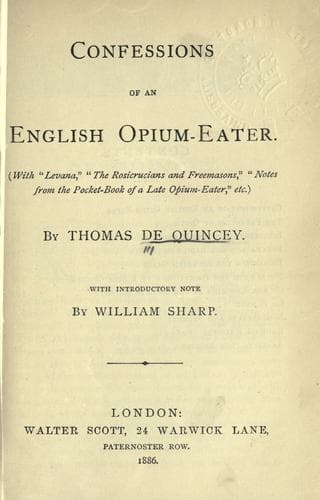
Note Book of an English Opium-EaterDe Quincey, Thomas
Philosophy
Note Book of an English Opium-Eater
De Quincey, Thomas
Opium abuse -- England
own; Bentley resigned himself luxuriously, without the whisper of a
scruple, to his own sense of what was or was not poetic, which sense
happened to be that of the adder for music. The deaf adder heareth not
though the musician charm ever so wisely. No scholarship, which so far
beyond other men Bentley had, could gain him the imaginative sensibility
which, in a degree so far beyond average men, he wanted. Consequently, the
world never before beheld such a scene of massacre as his 'Paradise Lost'
exhibited. He laid himself down to his work of extermination like the
brawniest of reapers going in steadily with his sickle, coat stripped off,
and shirt sleeves tucked up, to deal with an acre of barley. One duty, and
no other, rested upon _his_ conscience; one voice he heard--Slash away,
and hew down the rotten growths of this abominable amanuensis. The carnage
was like that after a pitched battle. The very finest passages in every
book of the poem were marked by italics, as dedicated to fire and
slaughter. 'Slashing Dick' went through the whole forest, like a woodman
marking with white paint the giant trees that must all come down in a
month or so. And one naturally reverts to a passage in the poem itself,
where God the Father is supposed to say to his Filial assessor on the
heavenly throne, when marking the desolating progress of Sin and Death,--
'See with what havoc these fell dogs advance
To ravage this fair world.'
But still this inhuman extravagance of Bentley, in following out his
hypothesis, does not exonerate _us_ from bearing in mind so much
truth as that hypothesis really must have had, from the pitiable
difficulties of the great poet's situation.
My own opinion, therefore, upon the line, for instance, from 'Paradise
Regained,' which Mr. Landor appears to have indicated for the reader's
amazement, viz.:--
'As well might recommend
_Such solitude before choicest society_,'
is--that it escaped revision from some accident calling off the ear of
Milton whilst in the act of having the proof read to him. Mr. Landor
silently prints it in italics, without assigning his objection; but, of
course that objection must be--that the line has one foot too much. It is
an Alexandrine, such as Dryden scattered so profusely, without asking
himself why; but which Milton never tolerates except in the choruses of
the Samson.
'_Not difficult, if thou hearken to me_'--
is one of the lines which Mr. Landor thinks that 'no authority will
reconcile' to our ears. I think otherwise. The caesura is meant to fall
not with the comma after _difficult _, but after _thou_; and there is a
most effective and grand suspension intended. It is Satan who speaks--
Satan in the wilderness; and he marks, as he wishes to mark, the
tremendous opposition of attitude between the two parties to the
temptation.
'Not difficult if thou----'
Public-domain text, read in full here on John Shaqi.
Reviews
Reviews
No reviews yet
Be the first to share your thoughts on this work.
Elsewhere in the archive
Join the Discussion
Join the discussion
Sign in to leave a comment or review.
Sign InorCreate an account