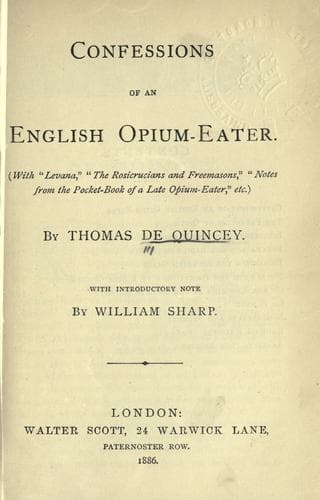
Note Book of an English Opium-EaterDe Quincey, Thomas
Philosophy
Note Book of an English Opium-Eater
De Quincey, Thomas
Opium abuse -- England
there let the reader pause, as if pulling up suddenly four horses in
harness, and throwing them on their haunches--not difficult if thou (in
some mysterious sense the son of God); and then, as with a burst of
thunder, again giving the reins to your _quadriga_,
'----hearken to me:'
that is, to me, that am the Prince of the Air, and able to perform all my
promises for those that hearken to any temptations.
Two lines are cited under the same ban of irreconcilability to our ears,
but on a very different plea. The first of these lines is--
'_Launcelot, or Pellias, or Pellinore;_'
The other
_'Quintius, Fabricius, Curius, Regulus._'
The reader will readily suppose that both are objected to as 'roll-calls
of proper names.' Now, it is very true that nothing is more offensive to
the mind than the practice of mechanically packing into metrical
successions, as if packing a portmanteau, names without meaning or
significance to the feelings. No man ever carried that atrocity so far as
Boileau, a fact of which Mr. Landor is well aware; and slight is the
sanction or excuse that can be drawn from _him_. But it must not be
forgotten that Virgil, so scrupulous in finish of composition, committed
this fault. I remember a passage ending
'----Noemonaque Prytaninque;'
but, having no Virgil within reach, I cannot at this moment quote it
accurately. Homer, with more excuse, however, from the rudeness of his
age, is a deadly offender in this way. But the cases from Milton are very
different. Milton was incapable of the Homeric or Virgilian blemish. The
objection to such rolling musketry of names is, that unless interspersed
with epithets, or broken into irregular groups by brief circumstances of
parentage, country, or romantic incident, they stand audaciously perking
up their heads like lots in a catalogue, arrow-headed palisades, or young
larches in a nursery ground, all occupying the same space, all drawn up in
line, all mere iterations of each other. But in
'_Quintius, Fabricius, Curius, Regulus,_'
though certainly not a good line _when insulated_ (better, however,
in its connection with the entire succession of which it forms part), the
apology is, that the massy weight of the separate characters enables them
to stand like granite pillars or pyramids, proud of their self-supporting
independency.
Mr. Landor makes one correction by a simple improvement in the
punctuation, which has a very fine effect. Rarely has so large a result
been distributed through a sentence by so slight a change. It is in the
'Samson.' Samson says, speaking of himself (as elsewhere) with that
profound pathos, which to all hearts invests Milton's own situation in the
days of his old age, when he was composing that drama--
'Ask for this great deliverer now, and find him
_Eyeless in Gaza at the mill with slaves._'
Public-domain text, read in full here on John Shaqi.
Reviews
Reviews
No reviews yet
Be the first to share your thoughts on this work.
Elsewhere in the archive
Join the Discussion
Join the discussion
Sign in to leave a comment or review.
Sign InorCreate an account