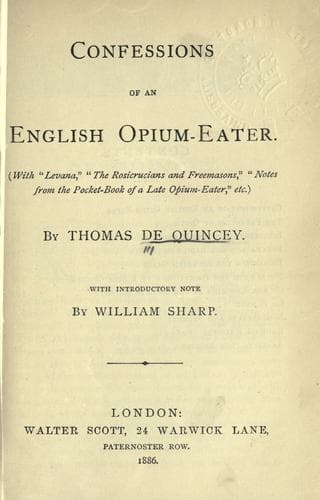
Note Book of an English Opium-EaterDe Quincey, Thomas
Philosophy
Note Book of an English Opium-Eater
De Quincey, Thomas
Opium abuse -- England
I am myself, and always have been, a member of the Church of England, and
am grieved to hear the many attacks against the Church [frequently most
illiberal attacks], which not so much religion as political rancor gives
birth to in every third journal that I take up. This I say to acquit
myself of all dishonorable feelings, such as I would abhor to co-operate
with, in bringing a very heavy charge against that great body in its
literary capacity. Whosoever has reflected on the history of the English
constitution--must be aware that the most important stage of its
development lies within the reign of Charles I. It is true that the
judicial execution of that prince has been allowed by many persons to
vitiate all that was done by the heroic parliament of November, 1640: and
the ordinary histories of England assume as a matter of course that the
whole period of parliamentary history through those times is to be
regarded as a period of confusion. Our constitution, say they, was formed
in 1688-9. Meantime it is evident to any reflecting man that the
revolution simply re-affirmed the principles developed in the strife
between the two great parties which had arisen in the reign of James I.,
and had ripened and come to issue with each other in the reign of his son.
Our constitution was not a birth of a single instant, as they would
represent it, but a gradual growth and development through a long tract of
time. In particular the doctrine of the king's vicarious responsibility in
the person of his ministers, which first gave a sane and salutary meaning
to the doctrine of the king's personal irresponsibility ['The king can do
no wrong'], arose undeniably between 1640 and 1648. This doctrine is the
main pillar of our constitution, and perhaps the finest discovery that was
ever made in the theory of government. Hitherto the doctrine _that the
King can do no wrong_ had been used not to protect the indispensable
sanctity of the king's constitutional character, but to protect the wrong.
Used in this way, it was a maxim of Oriental despotism, and fit only for a
nation where law had no empire. Many of the illustrious patriots of the
Great Parliament saw this; and felt the necessity of abolishing a maxim so
fatal to the just liberties of the people. But some of them fell into the
opposite error of supposing that this abolition could be effected only by
the direct negation of it; _their_ maxim accordingly was--'The king
_can_ do wrong,' _i.e._ is responsible in his own person. In this great
error even the illustrious wife of Colonel Hutchinson participated; [1]
and accordingly she taxes those of her own party who scrupled to accede to
the new maxim, and still adhered to the old one, with unconscientious
dealing. But she misapprehended their meaning, and failed to see where
they laid the emphasis: the emphasis was not laid, as it was by the royal
party, on the words 'can do no _wrong_'--but on 'The king:' that is, wrong
Public-domain text, read in full here on John Shaqi.
Reviews
Reviews
No reviews yet
Be the first to share your thoughts on this work.
Elsewhere in the archive
Join the Discussion
Join the discussion
Sign in to leave a comment or review.
Sign InorCreate an account