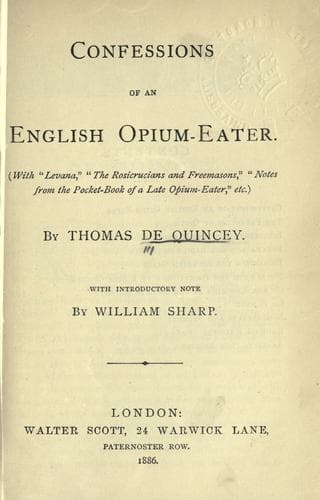
Note Book of an English Opium-EaterDe Quincey, Thomas
Philosophy
Note Book of an English Opium-Eater
De Quincey, Thomas
Opium abuse -- England
may be done; and in the king's name; but it cannot be the king who did it
[the king cannot constitutionally be supposed the person who did it]. By
this exquisite political refinement, the old tyrannical maxim was disarmed
of its sting; and the entire redress of all wrong, so indispensable to the
popular liberty, was brought into perfect reconciliation with the entire
inviolability of the sovereign, which is no less indispensable to the
popular liberty. There is moreover a double wisdom in the new sense: for
not only is one object [the redress of wrong] secured in conjunction with
another object [the king's inviolability] hitherto held irreconcilable,--
but even with a view to the first object alone a much more effectual means
is applied, because one which leads to no schism in the state, than could
have been applied by the blank negation of the maxim; _i.e._ by lodging
the responsibility exactly where the executive power [_ergo_ the power of
resisting this responsibility] was lodged. Here then is one example in
illustration of my thesis--that the English constitution was in a great
measure gradually evolved in the contest between the different parties in
the reign of Charles I. Now, if this be so, it follows that for
constitutional history no period is so important as that: and indeed,
though it is true that the Revolution is the great era for the
constitutional historian, because he there first finds the constitution
fully developed as the 'bright consummate _flower_,' and what is equally
important he there first finds the principles of our constitution
_ratified_ by a competent authority,--yet, to trace the _root_ and growth
of the constitution, the three reigns immediately preceding are still more
properly the objects of his study. In proportion then as the reign of
Charles I. is Important to the history of our constitution, in that
proportion are those to be taxed with the most dangerous of all possible
falsifications of our history, who have misrepresented either the facts or
the principles of those times. Now I affirm that the clergy of the Church
of England have been in a perpetual conspiracy since the era of the
restoration to misrepresent both. As an illustration of what I mean I
refer to the common edition of Hudibras by Dr. Grey: for the proof I might
refer to some thousands of books. Dr. Grey's is a disgusting case: for he
swallowed with the most anile credulity every story, the most extravagant
that the malice of those times could invent against either the
Presbyterians or the Independents: and for this I suppose amongst other
deformities his notes were deservedly ridiculed by Warburton. But, amongst
hundreds of illustrations more respectable than Dr. Grey's I will refer
the reader to a work of our own days, the Ecclesiastical Biography [in
part a republication of Walton's Lives] edited by the present master of
Trinity College, Cambridge, who is held in the highest esteem wherever he
Public-domain text, read in full here on John Shaqi.
Reviews
Reviews
No reviews yet
Be the first to share your thoughts on this work.
Elsewhere in the archive
Join the Discussion
Join the discussion
Sign in to leave a comment or review.
Sign InorCreate an account