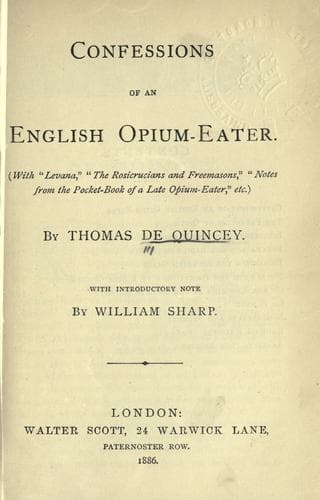
Note Book of an English Opium-EaterDe Quincey, Thomas
Philosophy
Note Book of an English Opium-Eater
De Quincey, Thomas
Opium abuse -- England
according to my remembrance) he has made a statement to this effect--That
the custom prevalent among children in that age of asking their parents'
blessing was probably first brought into disuse by the Puritans. Is it
possible to imagine a perversity of prejudice more unreasonable? The
unamiable side of the patriotic character in the seventeenth century was
unquestionably its religious bigotry; which, however, had its ground in a
real fervor of religious feeling and a real strength of religious
principle somewhat exceeding the ordinary standard of the 19th century.
But, however palliated, their bigotry is not to be denied; it was often
offensive from its excess; and ludicrous in its direction. Many harmless
customs, many ceremonies and rituals that had a high positive value, their
frantic intolerance quarrelled with: and for my part I heartily join in
the sentiment of Charles II.--applying it as he did, but a good deal more
extensively, that their religion 'was not a religion for a gentleman:'
indeed all sectarianism, but especially that which has a modern origin--
arising and growing up within our own memories, unsupported by a grand
traditional history of persecutions--conflicts--and martyrdoms, lurking
moreover in blind alleys, holes, corners, and tabernacles, must appear
spurious and mean in the eyes of him who has been bred up in the grand
classic forms of the Church of England or the Church of Rome. But, because
the bigotry of the Puritans was excessive and revolting, is _that_ a
reason for fastening upon them all the stray evils of omission or
commission for which no distinct fathers can be found? The learned editor
does not pretend that there is any positive evidence, or presumption even,
for imputing to the Puritans a dislike to the custom in question: but,
because he thinks it a good custom, his inference is that nobody could
have abolished it but the Puritans. Now who does not see that, if this had
been amongst the usages discountenanced by the Puritans, it would on that
account have been the more pertinaciously maintained by their enemies in
church and state? Or, even if this usage were of a nature to be prohibited
by authority, as the public use of the liturgy--organs--surplices, &c.,
who does not see that with regard to _that_ as well as to other
Puritanical innovations there would have been a reflux of zeal in the
restoration of the king which would have established them in more strength
than ever? But it is evident to the unprejudiced that the usage in
question gradually went out in submission to the altered spirit of the
times. It was one feature of a general system of manners, fitted by its
piety and simplicity for a pious and simple age, and which therefore even
the 17th century had already outgrown. It is not to be inferred that
filial affection and reverence have decayed amongst us, because they no
longer express themselves in the same way. In an age of imperfect culture,
Public-domain text, read in full here on John Shaqi.
Reviews
Reviews
No reviews yet
Be the first to share your thoughts on this work.
Elsewhere in the archive
Join the Discussion
Join the discussion
Sign in to leave a comment or review.
Sign InorCreate an account