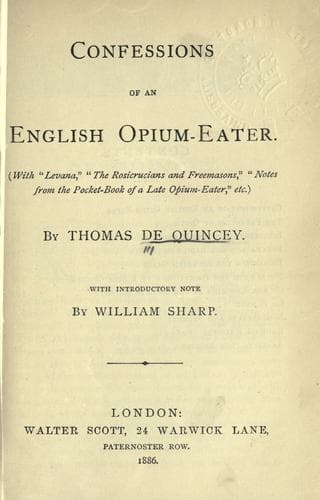
Note Book of an English Opium-EaterDe Quincey, Thomas
Philosophy
Note Book of an English Opium-Eater
De Quincey, Thomas
Opium abuse -- England
have carried this much too far: the literature of England must always be
in a considerable proportion lodged in their hands; and the extensive
means thus placed at their disposal for injuriously coloring that
important part of history they have used with no modesty or forbearance.
There is not a page of the national history even in its local subdivisions
which they have not stained with the atrabilious hue of their wounded
remembrances: hardly a town in England, which stood a siege for the king
or the parliament, but has some printed memorial of its constancy and its
sufferings; and in nine cases out of ten the editor is a clergyman of the
established church, who has contrived to deepen 'the sorrow of the time'
by the harshness of his commentary. Surely it is high time that the wounds
of the 17th century should close; that history should take a more
commanding and philosophic station; and that brotherly charity should now
lead us to a saner view of constitutional politics; or a saner view of
politics to a more comprehensive charity. The other cause of this
falsification springs out of a selfishness which has less claim to any
indulgence--viz. the timidity with which the English Whigs of former days
and the party to whom They [4] succeeded, constantly shrank from
acknowledging any alliance with the great men of the Long Parliament under
the nervous horror of being confounded with the regicides of 1649. It was
of such urgent importance to them, for any command over the public
support, that they should acquit themselves of an sentiment of lurking
toleration for regicide, with which their enemies never failed to load
them, that no mode of abjuring it seemed sufficiently emphatic to them
hence it was that Addison, with a view to the interest of his party,
thought fit when in Switzerland, to offer a puny insult to the memory of
General Ludlow; hence it is that even in our own days, no writers have
insulted Milton with so much bitterness and shameless irreverence as the
Whigs; though it is true that some few Whigs, more however in their
literary than in their political character, have stepped forward in his
vindication. At this moment I recollect a passage in the writings of a
modern Whig bishop--in which, for the sake of creating a charge of
falsehood against Milton, the author has grossly mis-translated a passage
in the _Defensio pro Pop. Anglicano_: and, if that bishop were not
dead, I would here take the liberty of rapping his knuckles--were it only
for breaking Priscian's head. To return over to the clerical feud against
the Long Parliament,--it was a passage in a very pleasing work of this day
(_Ecclesiastical Biography_) which suggested to me the whole of what
I have now written. Its learned editor, who is incapable of uncandid
feelings except in what concerns the interests of his order, has adopted
the usual tone in regard to the men of 1640 throughout his otherwise
valuable annotations: and somewhere or other (in the Life of Hammond,
Public-domain text, read in full here on John Shaqi.
Reviews
Reviews
No reviews yet
Be the first to share your thoughts on this work.
Elsewhere in the archive
Join the Discussion
Join the discussion
Sign in to leave a comment or review.
Sign InorCreate an account