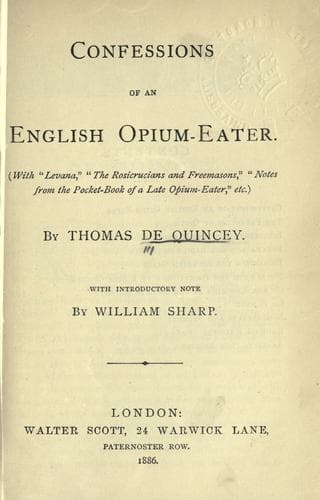
Note Book of an English Opium-EaterDe Quincey, Thomas
Philosophy
Note Book of an English Opium-Eater
De Quincey, Thomas
Opium abuse -- England
Constitution, as proclaimed and ratified in 1688-9, is in its kind, the
noblest work of the human mind working in conjunction with Time, and what
in such a case we may allowably call Providence. Of this _chef d'oeuvre_
of human wisdom it were desirable that we should have a proportionable
history: for such a history the great positive qualification would be a
philosophic mind: the great negative qualification would be this [which to
the established clergy may now be recommended as a fit subject for their
magnanimity]; viz. complete conquest over those prejudices which have
hitherto discolored the greatest era of patriotic virtue by contemplating
the great men of that era under their least happy aspect--namely, in
relation to the Established Church.
Now that I am on the subject of English History, I will notice one of the
thousand mis-statements of Hume's which becomes a memorable one from the
stress which he has laid upon it, and from the manner and situation in
which he has introduced it. Standing in the current of a narrative, it
would have merited a silent correction in an unpretending note: but it
occupies a much more assuming station; for it is introduced in a
philosophical essay; and being relied on for a particular purpose with the
most unqualified confidence, and being alleged in opposition to the very
highest authority [viz. the authority of an eminent person contemporary
with the fact] it must be looked on as involving a peremptory defiance to
all succeeding critics who might hesitate between the authority of Mr.
Hume at the distance of a century from the facts and Sir William Temple
speaking to them as a matter within his personal recollections. Sir
William Temple had represented himself as urging in a conversation with
Charles II., the hopelessness of any attempt on the part of an English
king to make himself a despotic and absolute monarch, except indeed
through the affections of his people. [5] This general thesis he had
supported by a variety of arguments; and, amongst the rest, he had
described himself as urging this--that even Cromwell had been unable to
establish himself in unlimited power, though supported by a military force
of _eighty thousand men_. Upon this Hume calls the reader's attention
to the extreme improbability which there must beforehand appear to be in
supposing that Sir W. Temple,--speaking of so recent a case, with so much
official knowledge of that case at his command, uncontradicted moreover by
the king whose side in the argument gave him an interest in contradicting
Sir William's statement, and whose means of information were paramount to
those of all others,--could under these circumstances be mistaken.
Doubtless, the reader will reply to Mr. Hume, the improbability _is_
extreme, and scarcely to be invalidated by any possible authority--which,
at best, must terminate in leaving an equilibrium of opposing evidence.
And yet, says Mr. Hume, Sir William was unquestionably wrong, and grossly
Public-domain text, read in full here on John Shaqi.
Reviews
Reviews
No reviews yet
Be the first to share your thoughts on this work.
Elsewhere in the archive
Join the Discussion
Join the discussion
Sign in to leave a comment or review.
Sign InorCreate an account