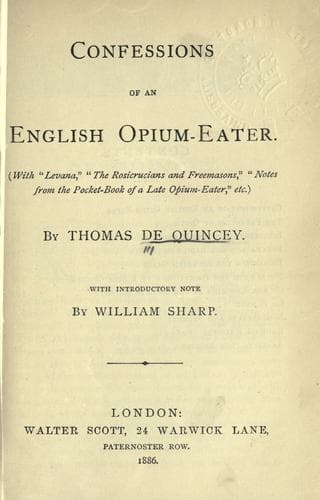
Note Book of an English Opium-EaterDe Quincey, Thomas
Philosophy
Note Book of an English Opium-Eater
De Quincey, Thomas
Opium abuse -- England
wrong: Cromwell never had an army at all approaching to the number of
eighty thousand. Now here is a sufficient proof that Hume had never read
Lord Clarendon's account of his own life: this book is not so common as
his 'History of the Rebellion;' and Hume had either not met with it, or
had neglected it. For, in the early part of this work, Lord Clarendon,
speaking of the army which was assembled on Blackheath to welcome the
return of Charles II., says that it amounted to fifty thousand men: and,
when it is remembered that this army was exclusive of the troops in
garrison--of the forces left by Monk in the North--and above all of the
entire army in Ireland,--it cannot be doubted that the whole would amount
to the number stated by Sir William Temple. Indeed Charles II. himself, in
the year 1678 [_i.e._ about four years after this conversation] as
Sir W. Temple elsewhere tells us, 'in six weeks' time raised an army of
twenty thousand men, the completest--and in all appearance the bravest
troops that could be any where seen, and might have raised many more; and
it was confessed by all the Foreign Ministers that no king in Christendom
could have made and completed such a levy as this appeared in such a
time.' William III. again, about eleven years afterwards, raised twenty-
three regiments with the same ease and in the same space of six weeks. It
may be objected indeed to such cases, as in fact it _was_ objected to
the case of William III. by Howlett in his sensible Examination of Dr.
Price's Essay on the Population of England, that, in an age when
manufactures were so little extended, it could ever have been difficult to
make such a levy of men--provided there were funds for paying and
equipping them. But, considering the extraordinary funds which were
disposable for this purpose in Ireland, &c. during the period of
Cromwell's Protectorate, we may very safely allow the combined authority
of Sir William Temple--of the king--and of that very prime minister who
disbanded Cromwell's army, to outweigh the single authority of Hume at the
distance of a century from the facts. Upon any question of fact, indeed,
Hume's authority is none at all.
FOOTNOTES.
Public-domain text, read in full here on John Shaqi.
Reviews
Reviews
No reviews yet
Be the first to share your thoughts on this work.
Elsewhere in the archive
Join the Discussion
Join the discussion
Sign in to leave a comment or review.
Sign InorCreate an account