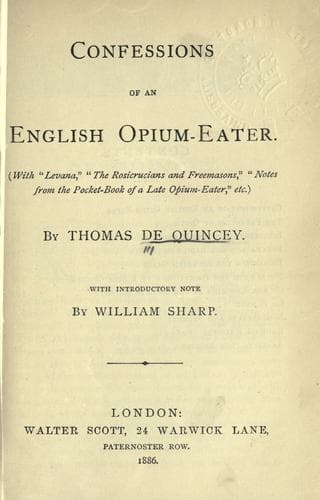
Note Book of an English Opium-EaterDe Quincey, Thomas
Philosophy
Note Book of an English Opium-Eater
De Quincey, Thomas
Opium abuse -- England
profound error of ascribing a phlegmatic character to the English nation.
'English phlegm' is the constant expression of authors when contrasting
the English with the French. Now the truth is, that, beyond that of all
other nations, it has a substratum of profound passion: and, if we are to
recur to the old doctrine of temperaments, the English character must be
classed not under the _phlegmatic_ but under the _melancholic_
temperament; and the French under the _sanguine_. The character of a
nation may be judged of in this particular by examining its idiomatic
language. The French, in whom the lower forms of passion are constantly
bubbling up from the shallow and superficial character of their feelings,
have appropriated all the phrases of passion to the service of trivial and
ordinary life: and hence they have no language of passion for the service
of poetry or of occasions really demanding it: for it has been already
enfeebled by continual association with cases of an unimpassioned order.
But a character of deeper passion has a perpetual standard in itself, by
which as by an instinct it tries all cases, and rejects the language of
passion as disproportionate and ludicrous where it is not fully justified.
'Ah Heavens!' or 'Oh my God!' are exclamations with us so exclusively
reserved for cases of profound interest,--that on hearing a woman even
(i.e. a person of the sex most easily excited) utter such words, we look
round expecting to see her child in some situation of danger. But, in
France, 'Ciel!' and 'Oh mon Dieu!' are uttered by every woman if a mouse
does but run across the floor. The ignorant and the thoughtless, however,
will continue to class the English character under the phlegmatic
temperament, whilst the philosopher will perceive that it is the exact
polar antithesis to a phlegmatic character. In this conclusion, though
otherwise expressed and illustrated, Walking Stewart's view of the English
character will be found to terminate: and his opinion is especially
valuable--first and chiefly, because he was a philosopher; secondly,
because his acquaintance with man civilized and uncivilized, under all
national distinctions, was absolutely unrivalled. Meantime, this and
others of his opinions were expressed in language that if literally
construed would often appear insane or absurd. The truth is, his long
intercourse with foreign nations had given something of a hybrid tincture
to his diction; in some of his works, for instance, he uses the French
word _helas!_ uniformly for the English _alas!_ and apparently with no
consciousness of his mistake. He had also this singularity about him
--that he was everlastingly metaphysicizing against metaphysics. To me,
who was buried in metaphysical reveries from my earliest days, this was
not likely to be an attraction any more than the vicious structure of his
diction was likely to please my scholarlike taste. All grounds of disgust,
Public-domain text, read in full here on John Shaqi.
Reviews
Reviews
No reviews yet
Be the first to share your thoughts on this work.
Elsewhere in the archive
Join the Discussion
Join the discussion
Sign in to leave a comment or review.
Sign InorCreate an account