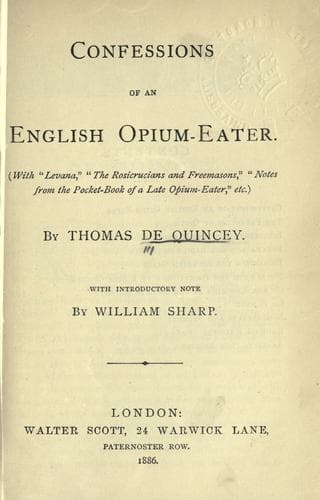
Note Book of an English Opium-EaterDe Quincey, Thomas
Philosophy
Note Book of an English Opium-Eater
De Quincey, Thomas
Opium abuse -- England
[3] Sir William and his cousin Sir Hardress Waller, were both remarkable
men. Sir Hardress had no conscience at all; Sir William a very scrupulous
one; which, however, he was for ever tampering with--and generally
succeeded in reducing into compliance with his immediate interest. He was,
however, an accomplished gentleman: and as a man of talents worthy of the
highest admiration.
[4] Until after the year 1688, I do not remember ever to have found the
term Whig applied except to the religious characteristics of that party:
whatever reference it might have to their political distinctions was only
secondary and by implication.
[5] Sir William had quoted to Charles a saying from Gourville (a Frenchman
whom the king esteemed, and whom Sir William himself considered the only
foreigner he had ever known that understood England) to this effect: 'That
a king of England who will be the man of his people, is the greatest king
in the world; but, if he will be something more, by G-- he is nothing at
all.'
A PERIPATETIC PHILOSOPHER.
He was a man of very extraordinary genius. He has generally been treated
by those who have spoken of him in print as a madman. But this is a
mistake and must have been founded chiefly on the titles of his books. He
was a man of fervid mind and of sublime aspirations: but he was no madman;
or, if he was, then I say that it is so far desirable to be a madman. In
1798 or 1799, when I must have been about thirteen years old, Walking
Stewart was in Bath--where my family at that time resided. He frequented
the pump-room, and I believe all public places--walking up and down, and
dispersing his philosophic opinions to the right and the left, like a
Grecian philosopher. The first time I saw him was at a concert in the
Upper Rooms; he was pointed out to me by one of my party as a very
eccentric man who had walked over the habitable globe. I remember that
Madame Mara was at that moment singing: and Walking Stewart, who was a
true lover of music (as I afterwards came to know), was hanging upon her
notes like a bee upon a jessamine flower. His countenance was striking,
and expressed the union of benignity with philosophic habits of thought.
In such health had his pedestrian exercises preserved him, connected with
his abstemious mode of living, that though he must at that time have been
considerably above forty, he did not look older than twenty-eight; at
least the face which remained upon my recollection for some years was that
of a young man. Nearly ten years afterwards I became acquainted with him.
During the interval I had picked up one of his works in Bristol,--viz. his
_Travels to discover the Source of Moral Motion_, the second volume
of which is entitled _The Apocalypse of Nature_. I had been greatly
impressed by the sound and original views which in the first volume he had
taken of the national characters throughout Europe. In particular he was
the first, and so far as I know the only writer who had noticed the
Public-domain text, read in full here on John Shaqi.
Reviews
Reviews
No reviews yet
Be the first to share your thoughts on this work.
Elsewhere in the archive
Join the Discussion
Join the discussion
Sign in to leave a comment or review.
Sign InorCreate an account