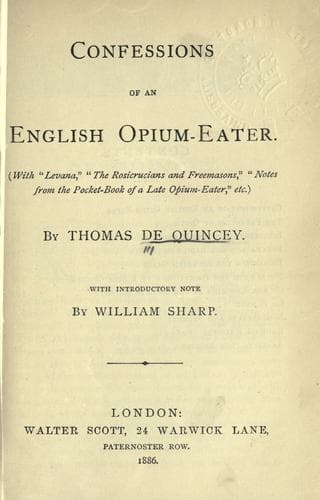
Note Book of an English Opium-EaterDe Quincey, Thomas
Philosophy
Note Book of an English Opium-Eater
De Quincey, Thomas
Opium abuse -- England
added a long note on Spanish affairs which is printed in the Appendix. The
opinions I expressed in this note on the Spanish character at that time
much calumniated, on the retreat to Corunna then fresh in the public mind,
above all, the contempt I expressed for the superstition in respect to the
French military prowess which was then universal and at its height, and
which gave way in fact only to the campaigns of 1814 and 1815, fell in, as
it happened, with Mr. Stewart's political creed in those points where at
that time it met with most opposition. In 1812 it was, I think, that I saw
him for the last time: and by the way, on the day of my parting with him,
I had an amusing proof in my own experience of that sort of ubiquity
ascribed to him by a witty writer in the London Magazine: I met him and
shook hands with him under Somerset-house, telling him that I should leave
town that evening for Westmoreland. Thence I went by the very shortest
road (_i.e._ through Moor-street, Soho--for I am learned in many
quarters of London) towards a point which necessarily led me through
Tottenham-court-road: I stopped nowhere, and walked fast: yet so it was
that in Tottenham-court-road I was not overtaken by (_that_ was
comprehensible), but overtook, Walking Stewart. Certainly, as the above
writer alleges, there must have been three Walking Stewarts in London. He
seemed no ways surprised at this himself, but explained to me that
somewhere or other in the neighborhood of Tottenham-court-road there was a
little theatre, at which there was dancing and occasionally good singing,
between which and a neighboring coffee-house he sometimes divided his
evenings. Singing, it seems, he could hear in spite of his deafness. In
this street I took my final leave of him; it turned out such; and,
anticipating at the time that it would be so, I looked after his white hat
at the moment it was disappearing and exclaimed--'Farewell, thou half-
crazy and most eloquent man! I shall never see thy face again.' I did not
intend, at that moment, to visit London again for some years: as it
happened, I was there for a short time in 1814: and then I heard, to my
great satisfaction, that Walking Stewart had recovered a considerable sum
(about 14,000 pounds I believe) from the East India Company; and from the
abstract given in the London Magazine of the Memoir by his relation, I
have since learned that he applied this money most wisely to the purchase
of an annuity, and that he 'persisted in living' too long for the peace of
an annuity office. So fare all companies East and West, and all annuity
offices, that stand opposed in interest to philosophers! In 1814, however,
to my great regret, I did not see him; for I was then taking a great deal
of opium, and never could contrive to issue to the light of day soon
enough for a morning call upon a philosopher of such early hours; and in
the evening I concluded that he would be generally abroad, from what he
Public-domain text, read in full here on John Shaqi.
Reviews
Reviews
No reviews yet
Be the first to share your thoughts on this work.
Elsewhere in the archive
Join the Discussion
Join the discussion
Sign in to leave a comment or review.
Sign InorCreate an account