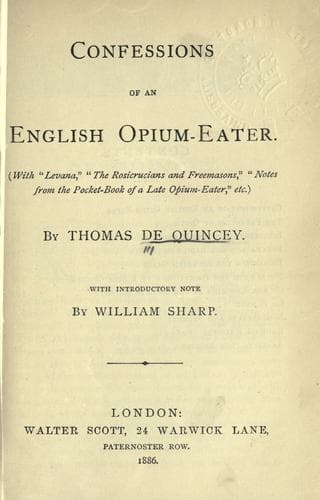
Note Book of an English Opium-EaterDe Quincey, Thomas
Philosophy
Note Book of an English Opium-Eater
De Quincey, Thomas
Opium abuse -- England
had formerly communicated to me of his own habits. It seems, however, that
he afterwards held _conversaziones_ at his own rooms; and did not
stir out to theatres quite so much. From a brother of mine, who at one
time occupied rooms in the same house with him, I learned that in other
respects he did not deviate in his prosperity from the philosophic tenor
of his former life. He abated nothing of his peripatetic exercises; and
repaired duly in the morning, as he had done in former years, to St.
James's Park,--where he sate in contemplative ease amongst the cows,
inhaling their balmy breath and pursuing his philosophic reveries. He had
also purchased an organ, or more than one, with which he solaced his
solitude and beguiled himself of uneasy thoughts if he ever had any.
The works of Walking Stewart must be read with some indulgence; the titles
are generally too lofty and pretending and somewhat extravagant; the
composition is lax and unprecise, as I have before said; and the doctrines
are occasionally very bold, incautiously stated, and too hardy and high-
toned for the nervous effeminacy of many modern moralists. But Walking
Stewart was a man who thought nobly of human nature: he wrote therefore at
times in the spirit and with the indignation of an ancient prophet against
the oppressors and destroyers of the time. In particular I remember that
in one or more of the pamphlets which I received from him at Grasmere he
expressed himself in such terms on the subject of Tyrannicide
(distinguishing the cases in which it was and was not lawful) as seemed to
Mr. Wordsworth and myself every way worthy of a philosopher; but, from the
way in which that subject was treated in the House of Commons, where it
was at that time occasionally introduced, it was plain that his doctrine
was not fitted for the luxurious and relaxed morals of the age. Like all
men who think nobly of human nature, Walking Stewart thought of it
hopefully. In some respects his hopes were wisely grounded; in others they
rested too much upon certain metaphysical speculations which are
untenable, and which satisfied himself only because his researches in that
track had been purely self-originated and self-disciplined. He relied upon
his own native strength of mind; but in questions, which the wisdom and
philosophy of every age building successively upon each other have not
been able to settle, no mind, however strong, is entitled to build wholly
upon itself. In many things he shocked the religious sense--especially as
it exists in unphilosophic minds; he held a sort of rude and unscientific
Spinosism; and he expressed it coarsely and in the way most likely to give
offence. And indeed there can be no stronger proof of the utter obscurity
in which his works have slumbered than that they should all have escaped
prosecution. He also allowed himself to look too lightly and indulgently
on the afflicting spectacle of female prostitution as it exists in London
and in all great cities.
Public-domain text, read in full here on John Shaqi.
Reviews
Reviews
No reviews yet
Be the first to share your thoughts on this work.
Elsewhere in the archive
Join the Discussion
Join the discussion
Sign in to leave a comment or review.
Sign InorCreate an account